Best Work Van for Your Business: A Complete Buyer's Guide — Routelink
Find the best work van for your delivery or service business. Compare payload, cargo volume, EV vs diesel, and total cost of ownership

24 August 2026 · Routelink Team
Best Work Van for Your Business: A Complete Buyer’s Guide
Find the best work van for your delivery or service business. Compare payload, cargo volume, EV vs diesel, and total cost of ownership
The popular advice is simple: buy the van with the highest payload, the most cargo space, or the lowest purchase price. That advice is incomplete, and it can put a small business into an expensive operational trap. The best work van is the one that fits your actual routes, cargo, drivers, loading routine, service network, and replacement plan.
A van that looks impressive on a specification sheet can waste time in tight streets, force unnecessary fuel or energy costs, require expensive modifications, or spend too long waiting for parts. A smaller vehicle may perform better when it matches the daily work. A larger van may be essential when the load is bulky, heavy, or difficult to handle. The correct decision starts with the logistics system, not the badge on the grille.
Table of Contents
- Why Most Van Buying Guides Get It Wrong
- Understanding Van Classes and Market Realities
- Comparing Top Work Vans by Operational Criteria
- Electric vs Diesel Vans for Real Delivery Routes
- Matching Vans to Your Specific Business Use Case
- Total Cost of Ownership Beyond the Sticker Price
- Test Drive Checklist and Route Planning Integration
Why Most Van Buying Guides Get It Wrong
Payload and purchase price matter, but they don’t describe how a van earns money. A courier van with generous payload capacity can still be a poor choice if drivers struggle to reach parcels quickly. A large cargo van can carry peak demand comfortably yet spend most working days half empty, harder to park, and more expensive to operate.
The missing concept is duty-cycle fit. Your duty cycle includes stop density, route length, road type, load variation, loading frequency, driver behavior, and depot access. A van used for dense urban deliveries faces different pressures from a van carrying tools to regional construction sites. The first needs fast access and maneuverability. The second may need cargo length, payload reserve, and comfortable highway driving.
The peak-load mistake
Many owners size a vehicle around an occasional maximum. That sounds prudent until the van spends the rest of its life carrying air. Oversizing also increases the cost of shelving, refrigeration equipment, liftgates, roof racks, tires, insurance, parking, and energy. Those costs can erase the apparent benefit of buying one larger platform.
Under-sizing creates the opposite problem. If the vehicle regularly carries dense equipment, the driver may need to rearrange cargo constantly or make extra trips. Overloaded operation also creates safety and maintenance risks. The answer isn’t to choose the biggest van. It’s to identify the normal load, the recurring peak load, and the items that require special access.
Practical rule: Buy for the route you run most often, then create a plan for the occasional peak. Don’t build an entire fleet around an exceptional week.
Operational friction is a real cost
Turning radius, door aperture, load-floor height, mirror visibility, and step-in height rarely receive the attention they deserve. Yet drivers interact with those features at every stop. A low load floor can make heavy equipment easier to move. A wide side door can reduce the time spent climbing through the cargo area. A shorter wheelbase can help a technician reach a residential driveway without repeated repositioning.
Upfitting deserves the same scrutiny. Shelving, bins, partitions, inverters, refrigeration, ladder racks, and security hardware change both weight and usable space. A van that appears cheaper before upfitting may become the more expensive choice once it needs a complex interior conversion.
The right buying question is therefore: which vehicle removes the most friction from this business? Evaluate access, loading, route geometry, service availability, and the way drivers work. Specs are useful only after those operating conditions are clear.
Understanding Van Classes and Market Realities
Van class is a logistics decision, not a badge on the grille. Compact vans suit light cargo and dense routes. Full-size vans provide more payload, volume, and configuration options. Heavy-duty and cutaway platforms fit high-volume freight or specialized bodies that a standard cargo van cannot support.
The market is large enough to affect parts availability, resale, and upfitting support. ACEA reported nearly 1.5 million new EU van registrations in 2023, reflecting the role vans play in freight, field service, and local delivery across Europe. The same analysis connected van-related industries with €860 billion in EU activity, or 5.1% of EU-wide GDP. For a small business, that scale usually means more established service networks and equipment options, but it also makes the market crowded with poorly matched configurations.
Work Van Classes at a Glance
| Van Class | Payload Range (lbs) | Cargo Volume (cu ft) | GVWR Range | Best For |
|---|---|---|---|---|
| Compact | Varies by configuration | Varies by configuration | Varies by configuration | Small parcels, light service tools, dense urban routes |
| Full-size | Varies by configuration | Varies by configuration | Varies by configuration | General delivery, trades, mobile workshops, regional service |
| Heavy-duty or cutaway | Varies by body and chassis | Varies by body and chassis | Varies by configuration | High-volume delivery, bulky freight, specialized bodies |
Treat the table as a starting point, not a specification sheet. Payload, cargo volume, and gross vehicle weight rating change with wheelbase, roof height, drivetrain, body, and upfit. The final door-jamb rating controls the working load. A generic model-page maximum does not account for shelving, partitions, tools, refrigeration, or other equipment added later.
Cargo volume and payload solve different problems. Merchant comparison data lists the Ram ProMaster with up to 462.9 cubic feet of cargo space, while the Ford Transit reaches a maximum payload of 4,640 pounds in the same comparison set. That comparison makes the trade-off clear. Volume helps irregular parcels and shelving fit efficiently. Payload determines whether the finished vehicle can carry those items safely, including the interior fittings themselves.
Class choice creates overhead
A larger van changes daily operations. Parking becomes harder, depots need more clearance, and insurance and maintenance planning may become more involved. Heavy-duty capacity makes sense for a delivery operation with recurring bulky loads. It wastes money and time for a technician working mainly in compact neighborhoods, where maneuvering and access matter more than unused volume.
Market timing also affects replacement decisions. EU van sales rose 15% to 840,409 units in the first half of 2024, while a later period showed slower growth, with EU van-type light commercial vehicle sales reaching 742,759 units in the first half of 2026 and growth slowing to 1.9%. Germany, Italy, and France declined during that period, while Spain grew. Replacement demand remains substantial, but local economic conditions and purchasing timing can change quickly.
Powertrain selection comes after duty-cycle fit. ACEA recorded electrically-chargeable vans at 10.2% of EU market share in the first three quarters of 2025, while diesel still held 81.7%. Choose the class that handles the route, then confirm that the chosen powertrain can complete its daily work without disrupting charging, payload, or dispatch schedules.
Comparing Top Work Vans by Operational Criteria
A useful comparison starts with the driver’s day, not the brochure. The Ford Transit, Mercedes-Benz Sprinter, Ram ProMaster, Chevrolet Express, Ford E-Transit, and BrightDrop Zevo can all be sensible choices, but they don’t solve the same operating problem.
The Ford Transit is the safest general-purpose shortlist for many fleets. It offers a broad configuration range, a mature commercial ecosystem, and strong parts familiarity in many markets. That flexibility helps businesses standardize vehicles across delivery, service, and workshop roles. Its weakness is that flexibility can tempt buyers into ordering more van than their routes require.
The Mercedes-Benz Sprinter earns consideration when high-roof access, long cargo length, and interior work space are central to the job. It suits mobile workshops, specialty installations, and operations that need technicians to organize or prepare equipment inside the vehicle. The trade-off is a premium ownership profile and a need to verify local service capability before committing.
The Ram ProMaster is particularly compelling for urban trades and loading-intensive work. Its front-wheel-drive layout and low load floor can reduce the effort required to move heavy items, while its boxier cargo shape supports practical shelving. Its headline cargo volume is substantial, but the completed upfit and payload calculation still determine whether it fits the business.
The Chevrolet Express remains a straightforward option for operators who value a familiar platform and accessible servicing. It can make sense for trades businesses that don’t need the newest cabin design or maximum roof height. The decision should focus on whether its cargo access, interior dimensions, and configuration support the work without expensive compromises.
Electric options such as the Ford E-Transit and BrightDrop Zevo deserve a route-based evaluation, not automatic approval or rejection. They can be attractive where charging is dependable and routes are predictable. They become harder to justify when drivers cover uncertain distances, operate far from base, or need maximum flexibility during seasonal surges.
Top Work Vans Compared by Operational Criteria
| Van Model | Maneuverability | Upfitting Options | Fuel/Energy Efficiency | Service Network | Best Operational Fit |
|---|---|---|---|---|---|
| Ford Transit | Balanced across configurations | Mature and broad | Depends on powertrain and load | Strong fleet familiarity | Mixed delivery and service fleets |
| Mercedes-Benz Sprinter | Larger footprint requires route discipline | Strong for high-roof specialist builds | Suitable for planned regional work | Verify local coverage | Mobile workshops and bulky equipment |
| Ram ProMaster | Low floor and front-wheel drive favor urban work | Strong for shelving and organized cargo | Depends on engine, load, and route | Confirm local commercial support | Trades and urban delivery |
| Chevrolet Express | Familiar traditional van behavior | Established aftermarket support | Depends on engine and operating pattern | Broad in many markets | Service businesses seeking simplicity |
| Ford E-Transit | Best where routes return to a charging base | Growing commercial ecosystem | Strongest when charging is planned | Check EV-trained coverage | Predictable urban and local routes |
| BrightDrop Zevo | Designed for delivery-oriented operations | Delivery-focused configurations | Best with controlled duty cycles | Confirm regional support | Fleet delivery with depot infrastructure |
Don’t choose a model because it wins one category. Choose the platform that gives drivers fast access, gives managers reliable service options, and leaves enough payload after the upfit is installed.
Electric vs Diesel Vans for Real Delivery Routes
Powertrain choice is a route-design decision, not a badge comparison. An electric van fits a predictable duty cycle with a ready depot, a known departure charge, dependable charging access, and enough dwell time before the next shift. Remove any of those conditions and charging can become a scheduling constraint that a diesel van avoids.
Urban multi-stop delivery is the clearest EV fit. Repeated braking supports regenerative energy recovery, while a van returning to base can charge on a planned schedule. Quiet operation and smooth low-speed control also suit residential stops. The operating margin still changes with cargo weight, cold weather, auxiliary equipment, heating, and stop-and-go delays. Route planning must track battery state and usable range, not map distance alone.
Charging downtime is an operational cost. It can delay the next departure, require a spare vehicle, or force a route to be split. Depot upgrades and charger access also belong in the purchase decision, alongside the vehicle price.
Suburban and highway routes leave less room for error. Higher speeds, hills, weather, longer distances, and limited charging options can reduce the remaining range margin. A diesel Transit or Sprinter remains the practical choice for rural service, emergency callouts, and businesses that cannot install reliable depot charging.
The market is shifting toward electrification, but diesel still suits a large share of commercial work. As noted earlier, electrically chargeable vans hold a growing share of registrations, while diesel remains the dominant choice. Let the duty cycle, charging setup, and cost of route disruption determine the decision.
EV vs Diesel Van Performance by Route Type
| Metric | EV Van (Urban Multi-Stop) | EV Van (Suburban/Highway) | Diesel Van (Urban Multi-Stop) | Diesel Van (Suburban/Highway) |
|---|---|---|---|---|
| Stop-and-go suitability | Strong, with regenerative braking | Moderate | Strong, though less optimized for repeated braking | Strong |
| Refueling or charging planning | Requires depot and route planning | Requires larger operating margin | Conventional refueling is widely available | Conventional refueling is widely available |
| Range predictability | Sensitive to load, weather, speed, and cabin energy use | More sensitive to speed and distance | Generally easier to plan across long routes | Strong fit for uncertain regional work |
| Best operating pattern | Fixed routes returning to base | Planned routes with charging access | Urban routes without charging infrastructure | Rural, regional, or variable routes |
| Main hidden cost | Charging downtime and infrastructure | Route disruption if charging is unavailable | Fuel exposure and engine maintenance | Fuel exposure and engine maintenance |
EV fleets should use Routelink’s route optimization guide to align stop sequence with battery limits, stop density, and available operating time. Software cannot add battery capacity, but disciplined planning can cut avoidable detours and prevent charger conflicts. A diesel van carries its own planning risks, including fuel exposure and engine maintenance, so the cheaper-looking choice can still cost more when its duty cycle is poorly matched.
Matching Vans to Your Specific Business Use Case
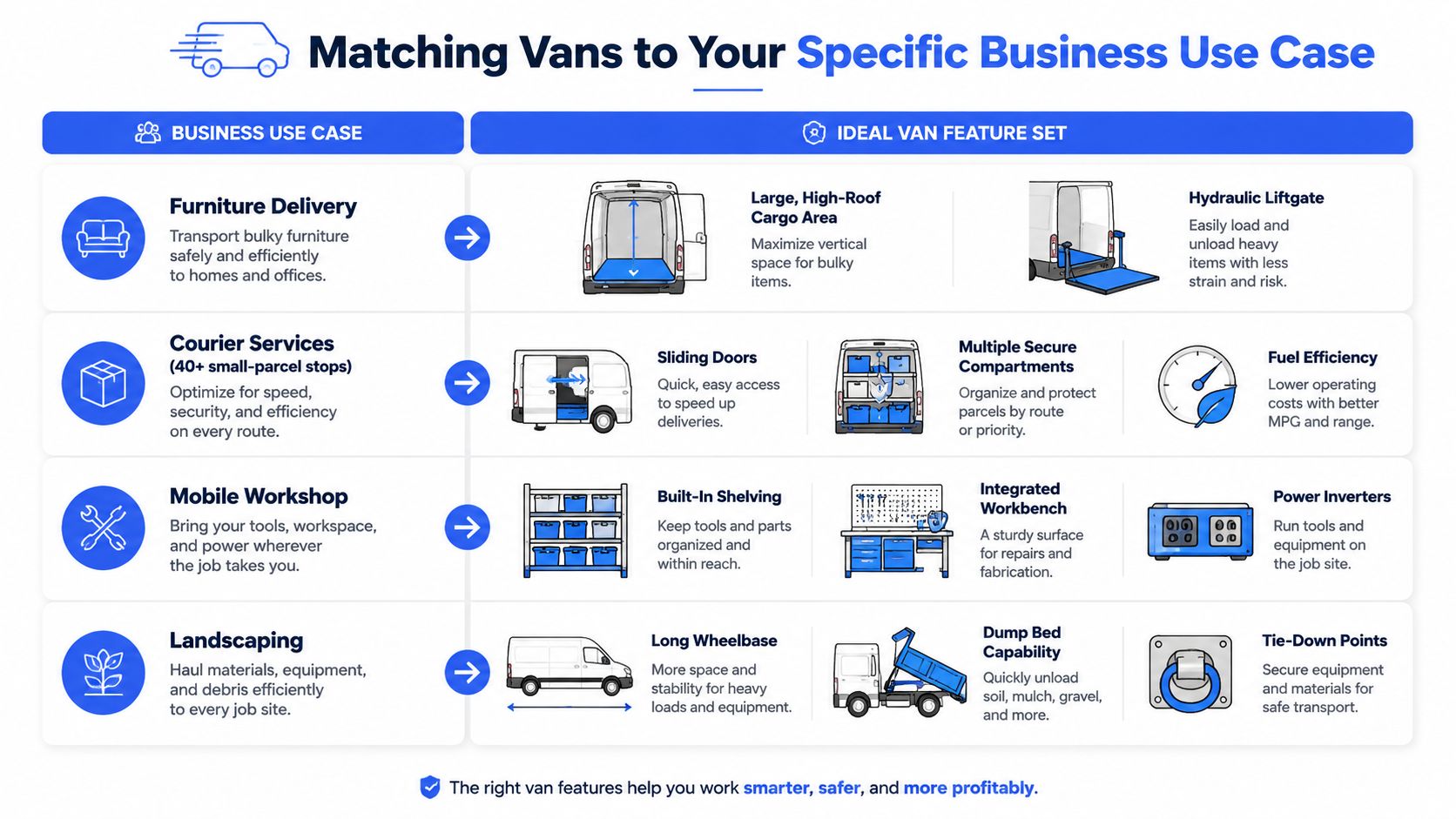
Start with the work, then specify the van. A furniture carrier needs open volume, wide access, and lifting capability. A courier needs rapid entry and exit. A plumber or electrician needs an organized mobile workshop, not an empty box with impressive cubic footage.
Furniture and appliance delivery
Choose a full-size or heavy-duty configuration when items are bulky, dense, or awkward to handle. Prioritize a high roof where the load requires vertical clearance, wide rear and side openings, and a load floor that works with carts. A liftgate may matter more than extra interior volume because the hard part is getting the item safely from pavement to cargo floor.
The major mistake is buying by cubic feet alone. Measure the actual furniture, packaging, doorways, and handling equipment. A van can have ample volume yet fail because the rear opening is too narrow or the payload disappears after adding a liftgate and interior protection.
Courier and parcel delivery
A compact or smaller full-size van is usually the better starting point for dense multi-stop work. Low step-in height, sliding-door access, secure compartments, good visibility, and a tight turning circle reduce repeated driver effort. If the vehicle returns to a depot, an electric model may fit well when charging is reliable and the route is stable.
Don’t pay for unused roof height or extended cargo length if the parcels are small. Every extra dimension can make parking and maneuvering harder without increasing useful delivery capacity.
Mobile workshop and landscaping
Plumbing, electrical, HVAC, and similar trades need shelving, bins, a secure bulkhead, lighting, power access, and a sensible place for long tools or materials. The Ram ProMaster’s low load floor can be a strong fit for frequent loading, while the Transit and Sprinter offer broad configuration and upfit choices. Confirm the weight of the finished shelving before selecting the payload rating.
Landscaping often requires a different body strategy. A long wheelbase, tie-down points, exterior storage, and possibly a dump-bed configuration can matter more than a tall enclosed body. If wet or dense materials are routine, leave meaningful payload reserve instead of operating near the limit every day.
For businesses building a dedicated local-delivery operation, Routelink’s cargo van business guide can help connect vehicle selection with capture, planning, dispatch, tracking, and proof-of-delivery requirements.
Total Cost of Ownership Beyond the Sticker Price
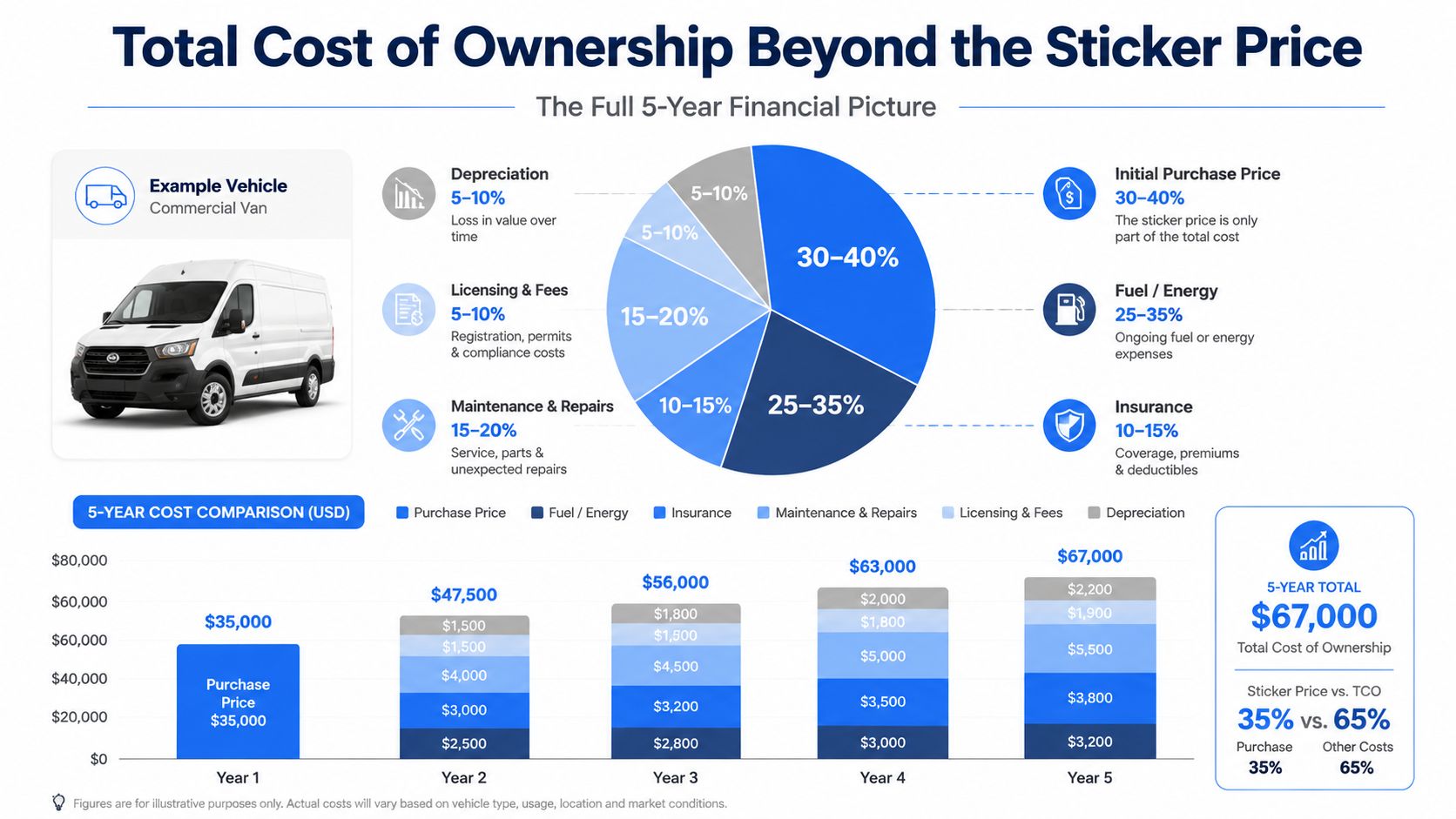
The purchase price is only the first financial decision. A work van also consumes fuel or energy, tires, maintenance capacity, insurance budget, driver time, and resale value. The cheapest van to acquire can become the most expensive if it needs specialized parts, suffers long repair delays, or forces additional trips.
Use a simple ownership model before you sign. Record the expected acquisition cost, financing, upfit, energy, scheduled maintenance, repairs, tires, insurance, licensing, downtime, and expected resale proceeds. Keep the model specific to the route and the final vehicle configuration. An empty-van estimate isn’t useful if the business will install refrigeration, shelving, a liftgate, or a heavy electrical system.
Downtime belongs in the calculation
A van sitting in a workshop isn’t just a repair invoice. It can mean missed deliveries, reassigned jobs, subcontractor costs, customer complaints, and pressure on the rest of the fleet. Ask the dealer how commercial repairs are handled, where parts are sourced, and whether your area has technicians familiar with the chosen powertrain.
Service-network density should influence the shortlist as much as cargo capacity. A platform with broad parts familiarity may protect revenue better than a feature-rich alternative that requires specialist support far from your depot.
Market conditions make timing harder. In the UK, SMMT reported a 12.1% fall in new light commercial vehicle registrations during the first half of 2025, while traditional large-panel vans still led June rankings. A softer market doesn’t automatically mean you should delay. It means you should compare immediate operating needs against availability, residual-value risk, and the cost of keeping an aging van productive.
Don’t assume an EV, diesel, or gasoline platform wins universally on ownership cost. The winner depends on utilization, charging, maintenance access, load, route conditions, and how long you keep the vehicle.
Test Drive Checklist and Route Planning Integration
A test drive should imitate the job. Inspect the van with the driver who’ll use it, and bring representative shelving, bins, tools, or parcels if possible. A quiet dealership loop won’t reveal the problems that appear after a full shift.
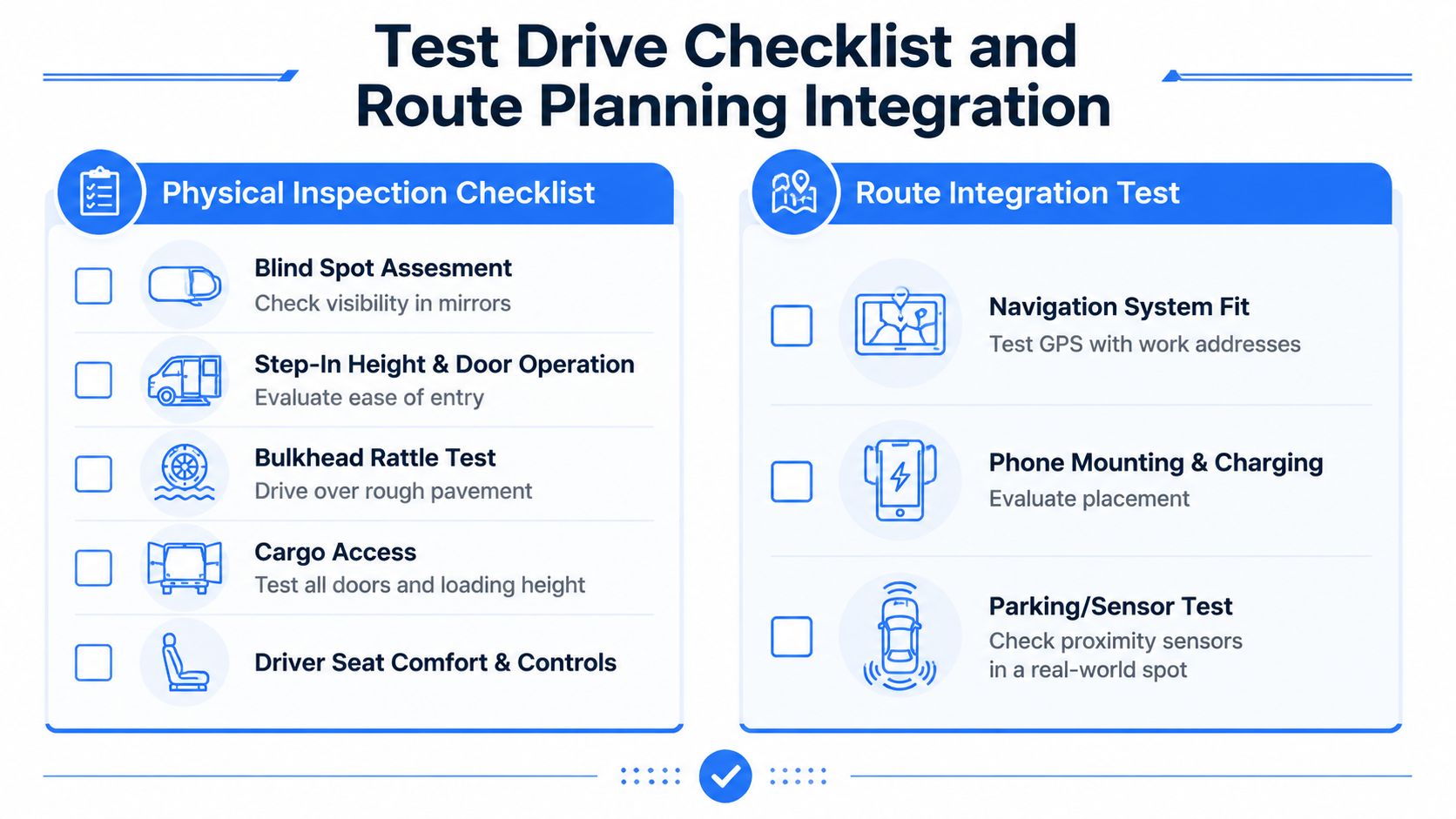
Use this checklist before committing:
- Enter and exit repeatedly: Test the step-in height, grab points, seat adjustment, and door effort. High-stop routes amplify small ergonomic problems.
- Check every sightline: Adjust mirrors, inspect blind spots, and test rear visibility with the cargo area configured as it will be in service.
- Drive rough pavement: Listen for bulkhead movement, shelving noise, rattles, and suspension behavior. A van that sounds loose during a short drive won’t improve on a full route.
- Load the cargo area: Test rear and side doors, loading height, aisle access, tie-down points, and whether the largest regular item can pass through the opening.
- Try a tight turn: Use a constrained parking area or narrow street. Note steering effort, camera usefulness, sensor behavior, and how much space the wheelbase needs.
- Test the driver workflow: Place the phone, scanner, paperwork, charger, and delivery equipment where they belong. If the cab becomes cluttered, drivers will work around the design every day.
Software and vehicle choice should support each other. Stop density, dwell time, proof-of-delivery requirements, and vehicle assignment affect the route plan. A high-frequency delivery van needs fast access and a clean driver workflow. A single-drop regional van needs comfort, range, and secure load management.
For the operational side, Routelink’s delivery driver route guidance addresses the connection between planned stops, driver navigation, customer communication, and delivery confirmation. Test the workflow with real work addresses before buying, including phone mounting, charging access, parking sensors, and proof-of-delivery steps.
The best work van isn’t the one that wins a brochure comparison. It’s the one your drivers can load, drive, park, service, and return to productive work without unnecessary friction.
Routelink brings job capture, route planning, dispatch, customer updates, navigation, and proof of delivery into one delivery workflow, with vehicle assignment available for route planning and tracking. Visit Routelink to see how it can help you match daily routes to the vans and drivers you already operate.