Operational Cost Reduction Playbook for 1PLs
Master operational cost reduction for local delivery. Diagnose hidden cost drivers, optimize routing, and implement tech to scale your 1PL profitably.
You can feel a local delivery operation losing money before the finance team can prove it.
It shows up at 8:10 a.m. when dispatch is still fixing yesterday’s address errors. A driver is waiting at the dock because the route sheet changed again. Customer service is already answering “where’s my order?” calls for stops that haven’t even left the depot. On paper, your big costs still look familiar: wages, fuel, vehicles, insurance. In practice, margin is leaking through manual work, stop-by-stop confusion, and avoidable rework.
That’s why operational cost reduction in a 1PL business rarely starts with cutting headcount or squeezing drivers harder. It starts with removing the friction that creates cost every day. In local delivery, that friction usually hides in dispatch, routing, loading, communication, proof of delivery, and exception handling. Fix those, and the P&L starts improving for the right reason.
Table of Contents
- The Hidden Margin Killers in Local Delivery
- Diagnosing Your True Cost Drivers
- Prioritizing Quick Wins in Routing and Staffing
- Implementing Technology to Eliminate Manual Friction
- Measuring KPIs and Sustaining the Savings
- Your 30-Day Delivery Optimization Checklist
The Hidden Margin Killers in Local Delivery
Most operators look at the obvious expense lines first. Fuel went up. Leases went up. Payroll is heavy. Those are real costs, but they’re often not the first place to attack.
The bigger issue is that many delivery teams keep regenerating cost through bad process design. Hidden-cost research makes this point clearly: organizations lose money through rework, delays, handoffs, and idle time, and those losses often don’t show up neatly in the accounting plan (research on hidden costs in SMEs). In local delivery, that translates into routes rebuilt by hand, drivers waiting for assignments, failed drops that trigger redelivery, and back-office staff cleaning up preventable mistakes.
Where the waste actually sits
A dispatch board can look busy and still be inefficient. That’s the trap.
If a planner spends the morning copying orders from email, spreadsheets, Shopify exports, and customer notes into separate systems, that labor doesn’t move a single parcel. If a route looks short on a map but cuts across slow traffic, congested turns, and poor stop sequencing, the route may be cheap on paper and expensive on the road.
Practical rule: If your team is doing the same admin work every day to keep deliveries moving, that isn’t “just operations.” It’s recurring waste.
Common hidden margin killers in 1PL delivery include:
- Manual dispatching: assigning stops by memory, spreadsheets, or whiteboards creates errors, uneven route loads, and late starts.
- Dock-side idle time: drivers burn paid time waiting for loads, corrections, keys, paperwork, or route changes.
- Failed deliveries: bad addresses, weak delivery windows, and missing customer contact details create second attempts and service calls.
- Exception handling: every “where is my order” call pulls office staff away from planning and issue prevention.
- Proof disputes: missing photos or signatures turn a completed stop into a back-office investigation.
Cost reduction isn’t the same as cost cutting
Lean manufacturing became a global model because it attacked waste at the process level, not just the budget line. Industry summaries report that lean programs commonly deliver 25% to 30% cost reductions, 70% to 90% lead-time improvements, and about 200% average ROI within 18 months, while a 2024 manufacturing survey found 87% of companies ranked factory cost reduction among their top three operational priorities (lean manufacturing statistics). The lesson for delivery isn’t “run a factory.” It’s that durable savings usually come from redesigning work.
That’s the shift many 1PLs need to make. Don’t ask, “What can we cut?” Ask, “What work keeps creating cost without adding value to the customer?” In a delivery network, that question usually leads straight to routing, dispatch, customer communication, and execution discipline.
Diagnosing Your True Cost Drivers
Before changing software, staffing, or route design, get honest about where the business is bleeding.
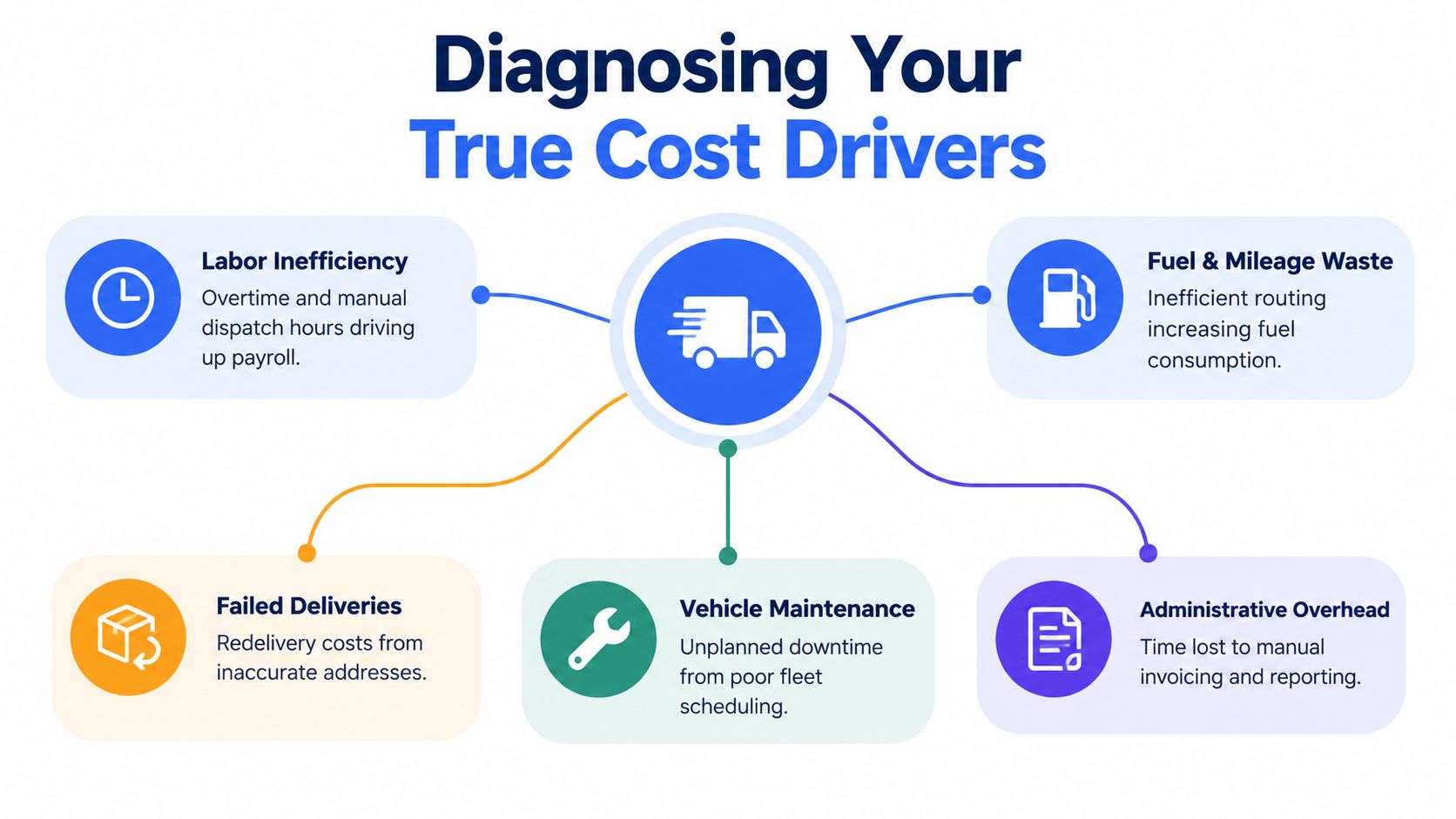
A lot of 1PLs rely on monthly P&L reviews to diagnose operations. That’s too late and too blunt. Finance will show that transport costs are high, but it won’t tell you whether the problem is route deviation, dead mileage, overtime from poor sequencing, repeated delivery attempts, or admin hours spent correcting bad order data.
Here’s a simple visual map of where delivery costs tend to originate:
Start with a route and labor baseline
You need a baseline before you can claim savings. Not a theoretical baseline. The current state, with all its mess.
I’d review one normal operating week and pull these categories:
| Cost area | What to inspect | What it usually reveals |
|---|---|---|
| Route performance | planned route vs actual path | avoidable detours, resequencing, extra miles |
| Driver time | shift start, departure, stop completion, return | loading delays, underused drivers, overtime pockets |
| Delivery success | first-attempt completion and exceptions | address quality issues, bad windows, customer no-shows |
| Admin effort | orders touched by office staff | duplicate entry, dispatch rework, invoice cleanup |
| Vehicle use | loaded vs empty movement | poor consolidation, weak territory planning |
One of the most practical benchmarks in delivery comes from green-routing research using large-scale travel data. It found that 31% of actual routes had fuel-saving potential, and cumulative fuel savings across those routes could reach 12% when actual traveled paths were compared with routes procured by navigation systems (JRC green-routing report). That matters because many operators still assume that if a driver got there, the route was good enough.
Separate visible costs from friction costs
Visible costs are easy to list. Fuel. Payroll. Repairs. Leases.
Friction costs hide inside those categories. A vehicle lease doesn’t tell you whether the van is under-loaded. Payroll doesn’t tell you whether your dispatcher is spending hours fixing orders that should have flowed in cleanly. Fuel spend doesn’t show whether route planning is optimizing for shortest distance when the better answer is lower fuel burn and fewer delays.
The route that looks shortest on the map often isn’t the cheapest route to operate.
That’s why a basic cost-per-mile view helps. If you need a clean framework for that math, this guide on how to calculate cost per mile is useful because it forces fixed and variable costs into one operating metric instead of treating every delivery day as a one-off.
For a broader finance lens, the Doczen operational savings guide is also worth reading. It’s helpful if your team needs a common language for cost reduction before you narrow it down to dispatch and local delivery.
Find the deviations first
Don’t audit everything at once. Start with the ugly routes.
Look for trips with repeated lateness, unusually high fuel use, too many stop edits, or frequent customer calls. Those are your high-deviation routes. They usually expose the root problem faster than average-performing runs do. In most fleets, the first meaningful savings come from fixing the worst recurring patterns, not from polishing already decent routes.
Prioritizing Quick Wins in Routing and Staffing
Once you know where the leaks are, go after the fixes that change daily economics fast. In a local delivery business, that usually means routing, load design, and staffing flexibility.
Operators often waste time on big strategy decks when they should be changing dispatch habits by tomorrow morning. Quick wins don’t need a transformation program. They need better operating choices.
Stop optimizing for distance alone
Shortest distance is a lazy routing goal. It looks efficient and often isn’t.
The green-routing findings earlier point to an important field reality: a route can be geographically shorter and still burn more fuel if it pushes drivers into worse traffic flow, more idling, harsher speed profiles, or poor turn patterns. Build routes around time, fuel behavior, stop density, and service windows, not just mileage.
A practical routing sequence looks like this:
-
Baseline actual runs
Pull the routes that consistently finish late, return with exceptions, or trigger high fuel spend. -
Test alternate sequencing
Change stop order, start zones, and delivery windows before changing territories. -
Prioritize high-deviation runs
Improve the routes with the biggest operational spread between plan and execution. -
Lock in repeatable route templates
If the same neighborhoods ship every week, stop rebuilding them from scratch.
The point isn’t to chase mathematical perfection. It’s to reduce bad repeat decisions.
If your team is evaluating route logic and tooling, this overview of route optimization for last-mile delivery gives a solid operational view of how planning constraints affect actual route quality.
Consolidate loads before you add vehicles
A lot of 1PLs respond to pressure by throwing on another van or pulling in another driver. Sometimes that’s necessary. Often it covers for weak load design.
Check these first:
- Order timing: Can certain orders be cut off earlier so routes leave cleaner and fuller?
- Territory overlap: Are two drivers crossing the same zone because sales promised narrow windows without ops input?
- Stop mix: Are bulky or time-sensitive jobs breaking route balance and forcing extra trips?
- Return flow: Are pickups being layered into routes that should stay delivery-only?
A partially filled vehicle costs nearly the same to start, staff, and dispatch as a well-loaded one. Better consolidation improves margin without reducing service. It also lowers operational stress because planners stop patching capacity gaps all day.
Build flexible staffing without creating dispatch chaos
Peak days create bad hiring decisions. Operators get burned by overstaffing after the spike or by dragging permanent staff into overtime because onboarding temporary help is too clunky.
The better answer is flexible execution with simple handoff rules. That means:
- Clear subcontractor packs: stop list, customer notes, delivery sequence, proof requirements.
- Simple access to work: no long onboarding process for occasional drivers.
- Tight delivery standards: temporary capacity still needs the same POD, communication, and timing rules.
- Defined zone ownership: if everyone can deliver anywhere, accountability disappears.
For a wider executive lens on where fast cost actions fit into company strategy, this cost cutting playbook for CEOs is a useful companion read. The local delivery version is more specific, but the core lesson holds: quick savings only stick when the operating model changes with them.
Implementing Technology to Eliminate Manual Friction
Technology helps only when it removes steps. If it gives the office another dashboard to maintain while drivers still text for addresses and customers still call for updates, it’s not solving the problem.
The strongest operational cost reduction moves in delivery come from replacing manual handling with connected workflows. Automation research consistently reports that basic automation typically cuts operational costs by 20% to 30%, more advanced intelligent automation can reach 50% to 70% reductions in targeted processes, and workflow automation examples show invoice processing dropping from roughly $10 to about $2 per invoice. The same body of research also notes outsourcing savings commonly cited in the 15% to 30% range, with some labor-intensive functions reaching higher in specific cases (automation and outsourcing cost benchmarks). For 1PLs, the lesson is simple: standardize repetitive work first, then automate it.
The workflow to automate first
Start at order capture.
If orders arrive from Shopify, WooCommerce, email, ERP exports, and spreadsheets, and a dispatcher still rekeys them into the delivery system, you’ve created an avoidable failure point. Bad addresses, duplicate stops, missing phone numbers, and wrong service windows often enter the business right there.
The first automation layer should include:
- Order import: direct sync from commerce systems or ERP where possible.
- Validation rules: catch incomplete addresses, missing contact details, and service-tag errors before dispatch.
- Planning constraints: vehicle capacity, delivery windows, territory, and driver availability.
- Dispatch handoff: drivers receive route details in a clean format without office follow-up.
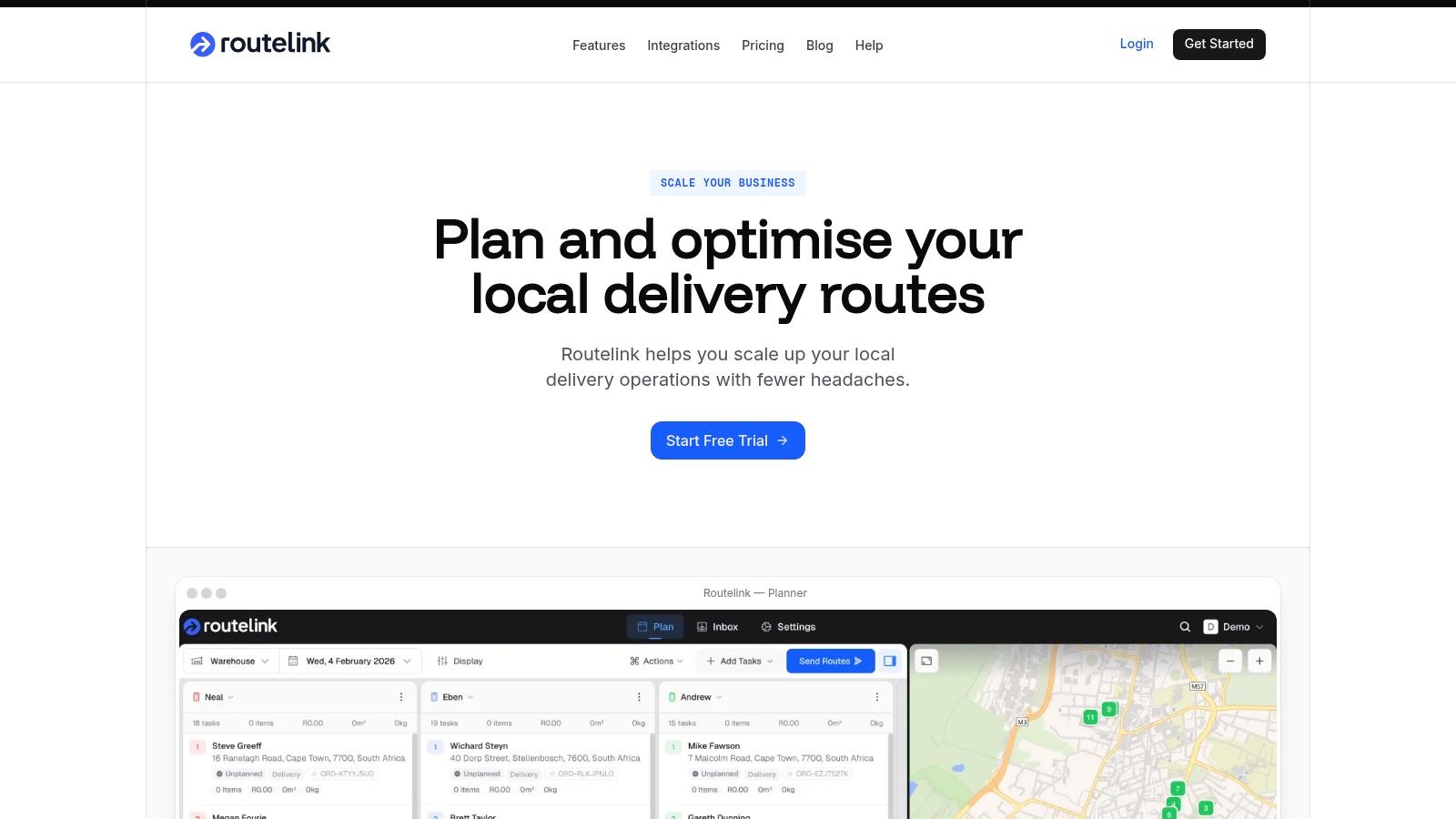
Here’s the kind of planning interface that matters in practice:
Remove customer-service work from the phone queue
Every “where is my driver?” call is a cost signal. It usually means the customer didn’t have enough visibility, the ETA wasn’t trusted, or the promised window was too vague.
Automated notifications reduce that load by moving routine updates into the customer’s hands. Email, SMS, WhatsApp, and live tracking links don’t just improve experience. They strip repetitive status-chasing out of your office workflow. That matters more than many admit, because support cost in delivery often hides inside general admin wages rather than standing on its own.
Good delivery tech doesn’t just route vehicles. It prevents avoidable conversations.
Make proof of delivery operational, not ceremonial
Proof of delivery needs to settle disputes quickly. A checkbox that says “delivered” doesn’t do much when a customer pushes back.
The practical standard is simple: photo evidence where appropriate, sign-on-glass e-signature where required, timestamped completion, and clean exception notes when a stop fails. That turns delivery completion into usable operational data instead of a vague claim.
One option in this category is dispatch scheduling software that combines planning, driver dispatch, notifications, and POD in one workflow. Routelink, for example, supports automatic imports, route planning, PIN-protected driver links without requiring an app, customer notifications, and photo or signature proof. The key point isn’t the brand. It’s that one connected system usually costs less than multiple disconnected handoffs managed by people.
Measuring KPIs and Sustaining the Savings
Initial savings are the easy part. Keeping them is where most operations slip.
BCG reported that executives achieved only 48% of their cost-saving targets in 2024, and that most companies struggle to sustain cost efficiencies beyond two years. It also noted examples where structural savings came with real implementation cost, including Capita incurring £53.2m of cash costs to deliver £250m of annualized savings, while Shell said nearly 60% of its structural savings came from operational efficiencies and faster decision-making rather than one-off cuts (BCG on sustaining cost efficiencies). That pattern shows up in logistics too. If the operation doesn’t change how it plans, dispatches, reviews, and corrects performance, cost creep comes back.
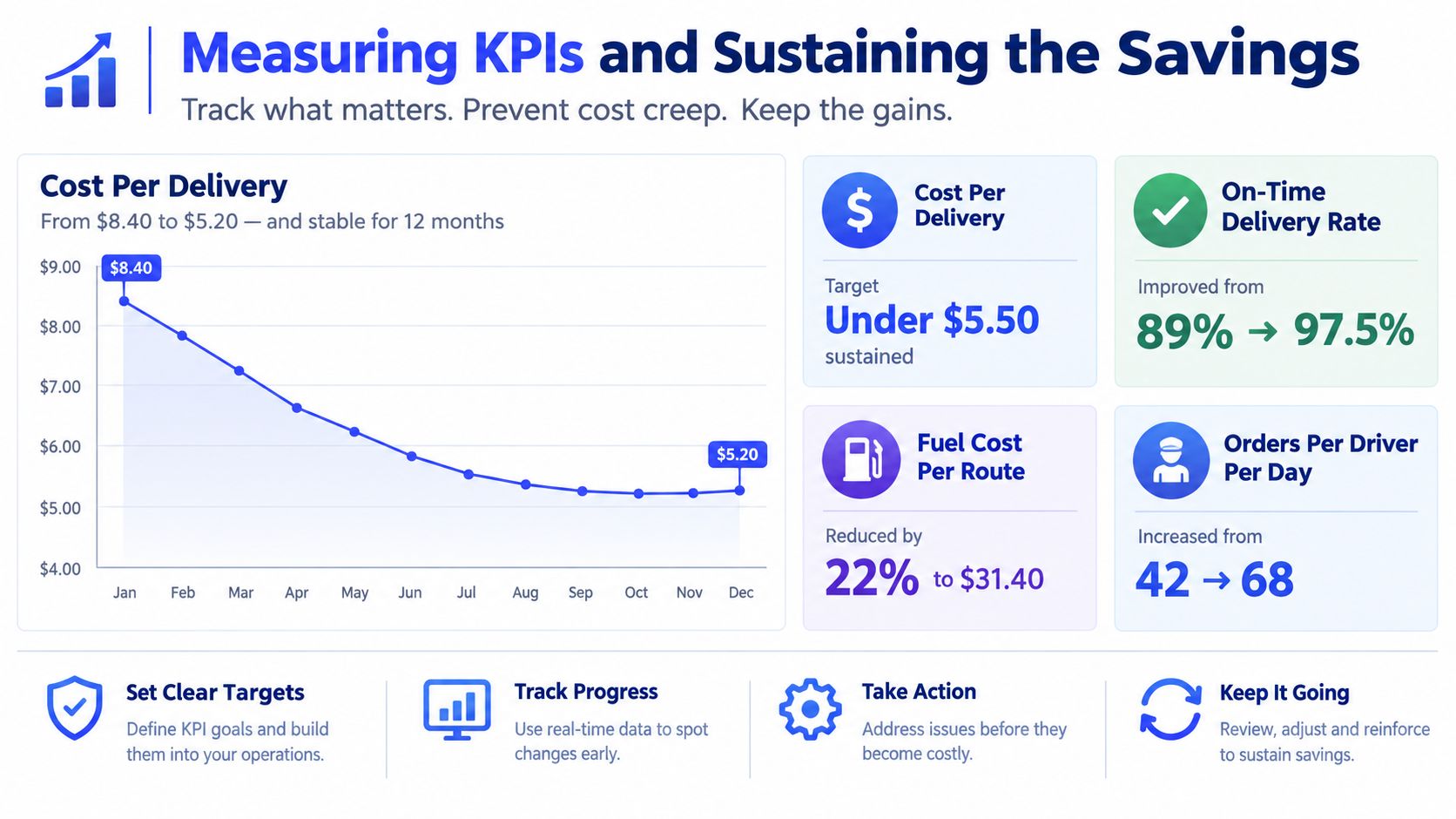
This visual captures the KPI view most 1PL teams need:
Track the few numbers that expose drift
Don’t build a giant dashboard no one uses. Track the metrics that tell you whether your previous fixes are holding.
I’d keep the weekly review focused on:
| KPI | What it tells you | Warning sign |
|---|---|---|
| Cost per delivery | whether route and labor efficiency are improving | stable volume but rising unit cost |
| On-time performance | whether planning is realistic and execution is disciplined | more late stops without more volume |
| Route deviation | whether drivers are following the planned logic | frequent off-plan movement |
| First-attempt delivery success | whether addresses, windows, and communication are working | redelivery volume starts climbing |
| Orders per driver | whether labor is being used well | more hours without more completed work |
These metrics matter together. Low cost per delivery with poor on-time performance usually means you’re starving service to make the spreadsheet look better. High orders per driver with rising failures usually means route compression went too far.
Build a review rhythm that operations can actually keep
Savings decay when reviews become occasional or political. A simple weekly ops review works better than a polished monthly presentation.
Use a short format:
- Review last week’s deviations
- Choose the top recurring failure pattern
- Assign one owner
- Change one operating rule
- Check the result next week
Faster decision-making usually protects savings better than one more broad cost-cutting round.
That’s also why structural savings tend to last longer than one-time cuts. If planners, dispatchers, and drivers are all working inside a cleaner system, you don’t have to keep “finding savings.” The operation stops recreating the same waste.
Your 30-Day Delivery Optimization Checklist
You don’t need a six-month transformation plan to start reducing delivery cost. You need four disciplined weeks and a willingness to expose the habits that office teams work around.
Here’s the implementation path I’d use for a 1PL operation that’s already running daily routes and can’t afford disruption.
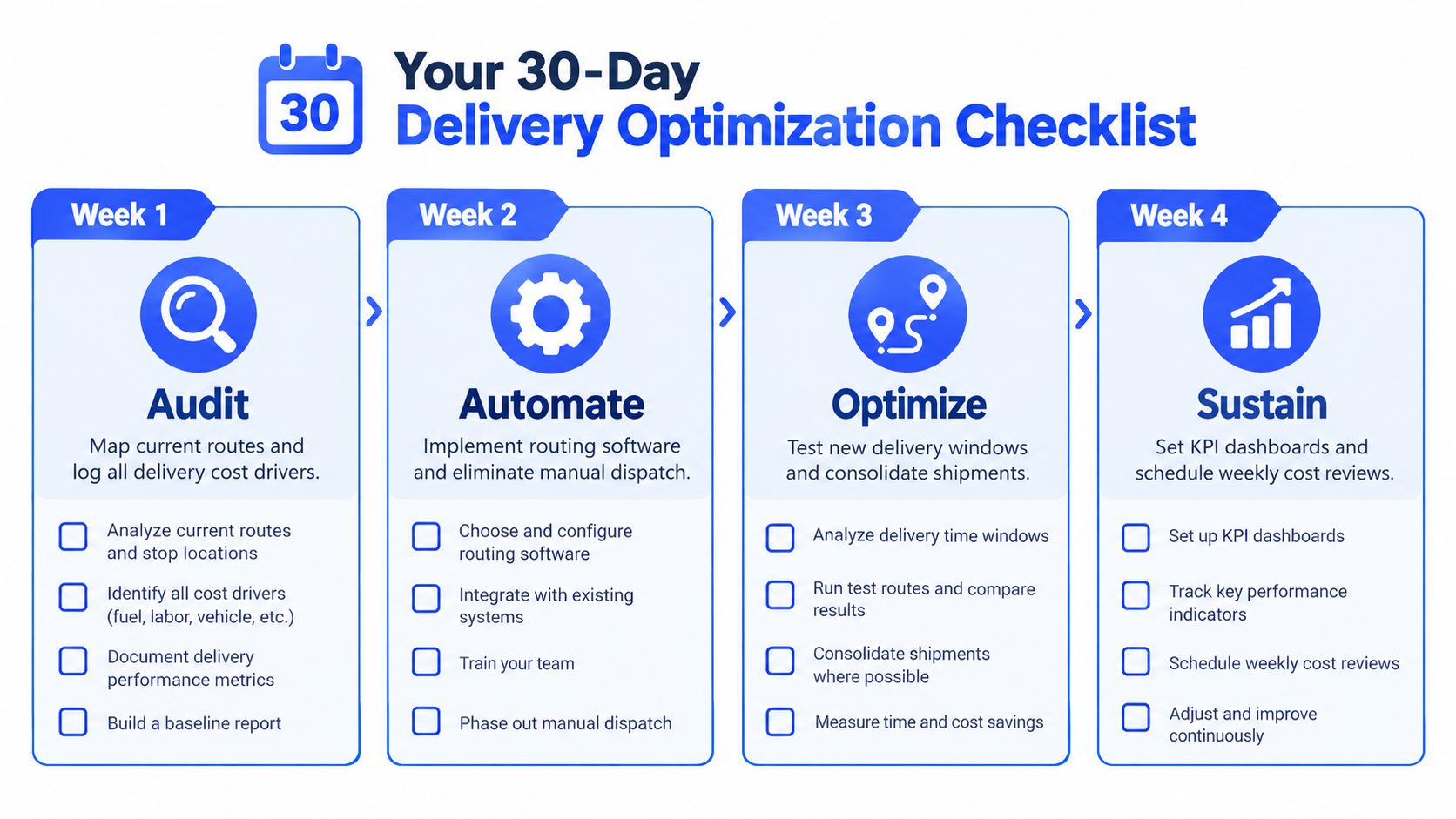
Week 1 audit the current state
Don’t start by shopping for software. Start by watching work.
Shadow dispatch for a full cycle, from order intake to route release. Record where orders are retyped, where drivers wait, where customer service intervenes, and where proof of delivery breaks down. Pull one week of route plans versus actual execution and flag the recurring exceptions.
Use this short checklist:
- Map order flow: where does an order begin, and how many times does a person touch it before dispatch?
- Log failed stops: note the reason, not just the outcome.
- Time the depot process: loading delays often get treated like “normal mornings” when they’re fixable waste.
- Review route edits: if planners are making constant manual changes, ask why the upstream data is unstable.
Week 2 automate the repeatable work
This is the week to remove duplicate handling.
Connect order sources where possible. Standardize service tags, customer notes, and proof requirements. Set dispatch rules that reflect how the operation runs, not how someone thinks it runs. If a driver or subcontractor needs work access, make the handoff simple enough that your team doesn’t spend the morning doing technical support.
A few things to tighten fast:
- Stop free-text chaos: use standard reason codes for failed delivery and exceptions.
- Clean customer data rules: no route should leave without the details drivers need.
- Centralize dispatch output: route sheets, customer ETAs, and POD instructions should come from one workflow.
Week 3 optimize routes and staffing behavior
Only after the workflow is cleaner should you start changing route design aggressively.
Take the highest-deviation routes first. Test better delivery windows, cleaner stop grouping, and improved load consolidation. Review where temporary drivers or subcontractors can cover peak demand without creating a second admin burden for dispatch.
Keep the experiments small and operational:
- Change a limited set of routes.
- Compare planned versus actual execution.
- Keep what reduces friction.
- Drop what creates new exceptions.
Week 4 lock in the operating discipline
Improvement efforts lose momentum after initial changes are made, and review stops.
Set one weekly KPI meeting. Keep it short. Focus on exceptions, route quality, failed deliveries, and labor use. Make one person accountable for each recurring issue and close the loop the following week.
The goal at the end of 30 days isn’t perfection. It’s a delivery operation with fewer manual touches, fewer preventable failures, and fewer hidden costs regenerating in the background.
If your team wants one system to handle capture, planning, dispatch, customer notifications, and proof of delivery without adding more admin work, Routelink is built for that workflow. It’s a practical fit for 1PL operators who need to cut routing waste, reduce manual dispatch friction, and scale local delivery with tighter operational control.