Customer Delivery Experience Playbook
Master the customer delivery experience with practical playbooks for routing, tracking, and driver workflows that reduce friction and build loyalty.

The truck is loaded, the first driver is waiting, and the dispatch board already contains more exceptions than planned stops. One address is missing a building number, another customer has asked for a call before arrival, and a heavy delivery has been assigned to a route with no clear access instructions. The customer doesn’t see any of that. They see a promised delivery window, an ETA, and a brand they expect to keep its word.
That gap between what the operation knows and what the customer experiences is where delivery quality is won or lost. A reliable customer delivery experience depends on more than getting goods from a depot to a doorstep. It includes accurate order information, realistic promises, route execution, useful updates, accessible handover procedures, and clear proof that the delivery was completed.
Table of Contents
- Defining the Modern Customer Delivery Experience
- Identifying Delivery Pain Points and Essential KPIs
- Optimizing Dispatch and Routing Workflows
- Managing Driver Execution and Customer Visibility
- Addressing Accessibility and Complex Drop Requirements
- Adapting Operations for Specific Local Industries
- Implementing a Delivery Management Platform
Defining the Modern Customer Delivery Experience
The customer has arranged a heavy delivery to a narrow residential site. The order is confirmed, the promised window looks workable, but the route still needs a vehicle that can reach the property, a driver who knows where to tip the load, and a contact who can resolve access problems. That is the modern delivery experience in practice. It begins at checkout and ends only when the goods are handed over, placed safely, or returned with a documented reason.
The customer evaluates the entire chain of promises: the delivery option, time window, confirmation message, tracking updates, handover, and condition on arrival. A completed stop can still produce a poor experience if the driver cannot find the property, the goods arrive damaged, or a delay is left unexplained. Research from a 2025 survey of 500 U.S. consumers found that 76% said a positive delivery experience influenced their decision to repurchase, compared with 72% in 2024. Nearly half also said poor delivery or packaging experiences would stop them buying from a brand. The 2025 delivery experience survey from Sifted shows why delivery belongs in retention planning as well as the transport budget.
The customer sees a chain of promises
Consider a landscaping supplier delivering aggregate to a residential project. The customer needs confidence that the driver has the correct address, understands where the load can be tipped, knows about access restrictions, and can reach someone if the planned drop point is blocked. A fast arrival has limited value when the truck cannot safely complete the drop.
Furniture, appliances, solid fuel, food, and trade supplies create similar demands. Delivery options, tracking visibility, condition on arrival, driver conduct, and proof of delivery all shape the customer’s judgment. The same survey found that 63% considered full shipment visibility throughout delivery essential, 53% said multiple shipping options made them more likely to complete a purchase, and fast delivery was the most valued feature for 37% of respondents. The 2025 delivery experience survey from Sifted cannot be cited again, so these findings should be treated as part of the same research context, with the link provided above.
An operations manager should ask: What does the customer need to know or do at each handoff? The answer exposes gaps that a delivered-versus-not-delivered report will miss, especially on multi-drop routes where access instructions, call-ahead requests, and unloading requirements vary by stop.
Delivery is part of retention
A late multi-drop route can affect future revenue even when every stop is eventually completed. Customers remember whether they had to call for an update, whether the driver arrived within the agreed window, and whether the product was left in usable condition. Reliable updates and clear handover records reduce uncertainty after the sale.
For a broader view of how post-checkout interactions shape the buying journey, NanoPIM’s ecommerce experience insights offer useful complementary context. Design the loading plan and the customer promise together. Where the route cannot support the promised window, adjust the plan or the promise before publishing an ETA.
Identifying Delivery Pain Points and Essential KPIs
Most delivery complaints begin as ordinary operational defects. A dispatcher imports an incomplete address, a planner sequences stops by habit rather than time window, or a driver reaches a site without the access note that was buried in an email. Each issue consumes time at the depot, on the road, or in customer support.
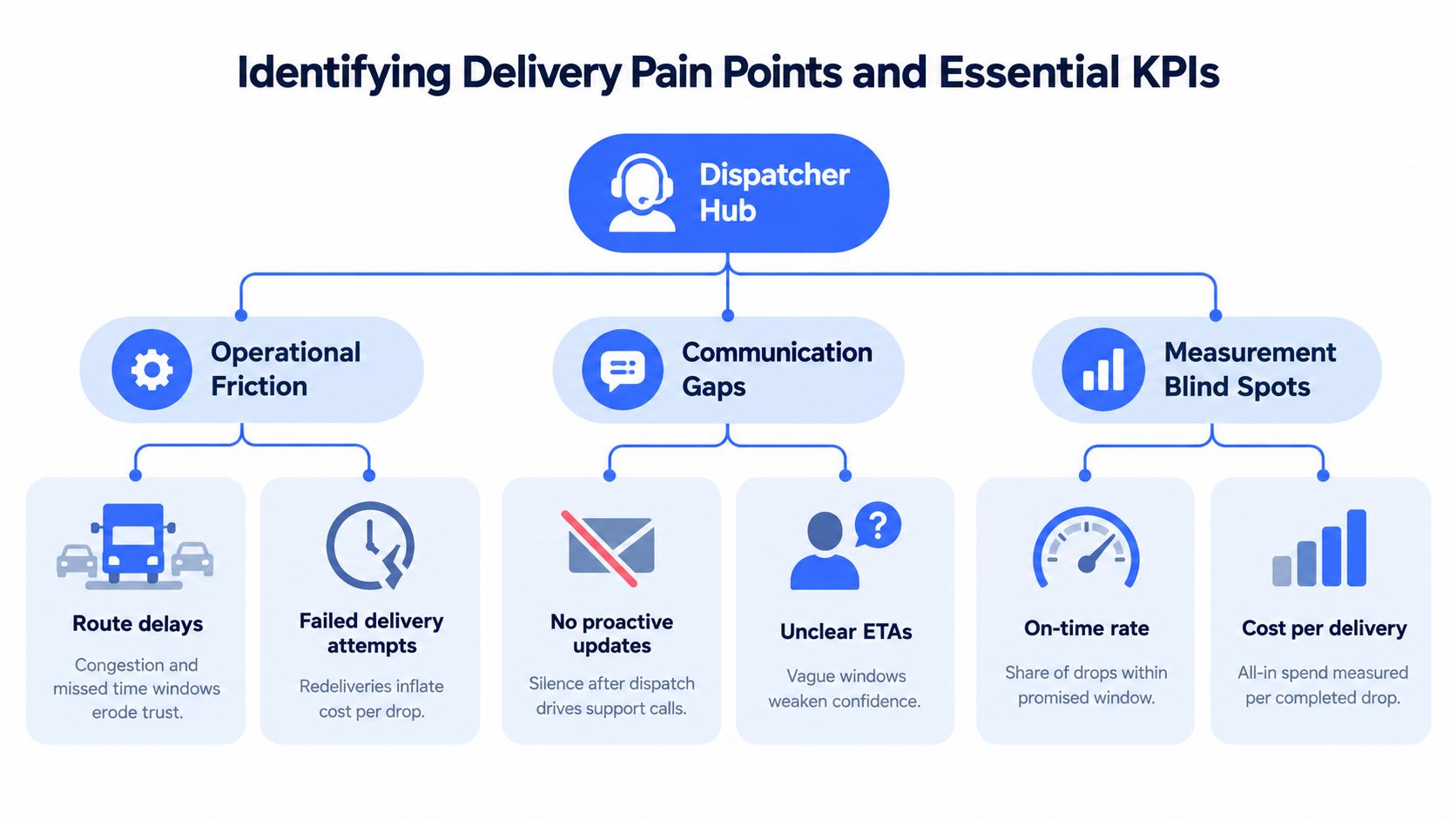
The most damaging blind spot is measuring activity instead of outcomes. A route can show as completed while customers experience missed windows, unclear handovers, or repeated calls. Start with the measures that reflect the promise made to the customer, then use operational detail to explain the result.
Put reliability at the top
The first KPI should be on-time-in-window percentage, calculated against the delivery window promised to the customer. A driver arriving early may still create a problem if the customer isn’t ready, while a late arrival can disrupt a building site, kitchen installation, or commercial receiving schedule.
Next, monitor failed-delivery rate, then order accuracy, and finally notification engagement. Track ETA accuracy as a separate operational measure by comparing the communicated arrival time with the actual arrival event. This hierarchy keeps notifications in their proper role. A message can’t repair an infeasible route, but it can make a manageable delay easier for the customer to handle.
One empirical study reported a moderate-to-strong relationship between a last-mile delivery-efficiency index and satisfaction, with r = 0.612, p < 0.001. It identified speed and reliability as the strongest individual predictors, with r = 0.527, ahead of delivery flexibility, order accuracy, and communication. The empirical last-mile delivery study supports a practical priority: improve punctual execution before adding cosmetic customer-facing features. The relationship is observational, so it doesn’t prove that route optimization alone causes satisfaction gains, but it gives managers a defensible order of work.
Diagnose the reason behind the score
A weak on-time result isn’t a diagnosis. Break it into address errors, depot loading delays, congestion, excessive dwell time, route overload, customer unavailability, vehicle issues, and access problems. Give each failed stop a reason code that the dispatcher can review without reading a long driver note.
A useful dispatch review asks:
- Promise quality: Was the time window realistic for the available vehicle, driver, load, and route?
- Data quality: Did the stop have a validated address, contact number, access instruction, and item requirement?
- Sequence quality: Did the route respect time windows, service duration, vehicle limits, and depot constraints?
- Exception handling: Did the customer receive an update before the missed window became a complaint?
For a practical explanation of how to connect operational performance with customer outcomes, review Routelink’s guidance on keeping deliveries on schedule. The goal isn’t to produce a larger report. It’s to identify the repeatable failure that a planner can prevent on the next run.
Optimizing Dispatch and Routing Workflows
A dependable route starts with clean intake. Orders sitting across spreadsheets, ecommerce systems, email threads, and sales platforms create different versions of the truth. Dispatchers then spend the morning reconciling addresses instead of checking capacity and feasibility.
Build a controlled intake sequence
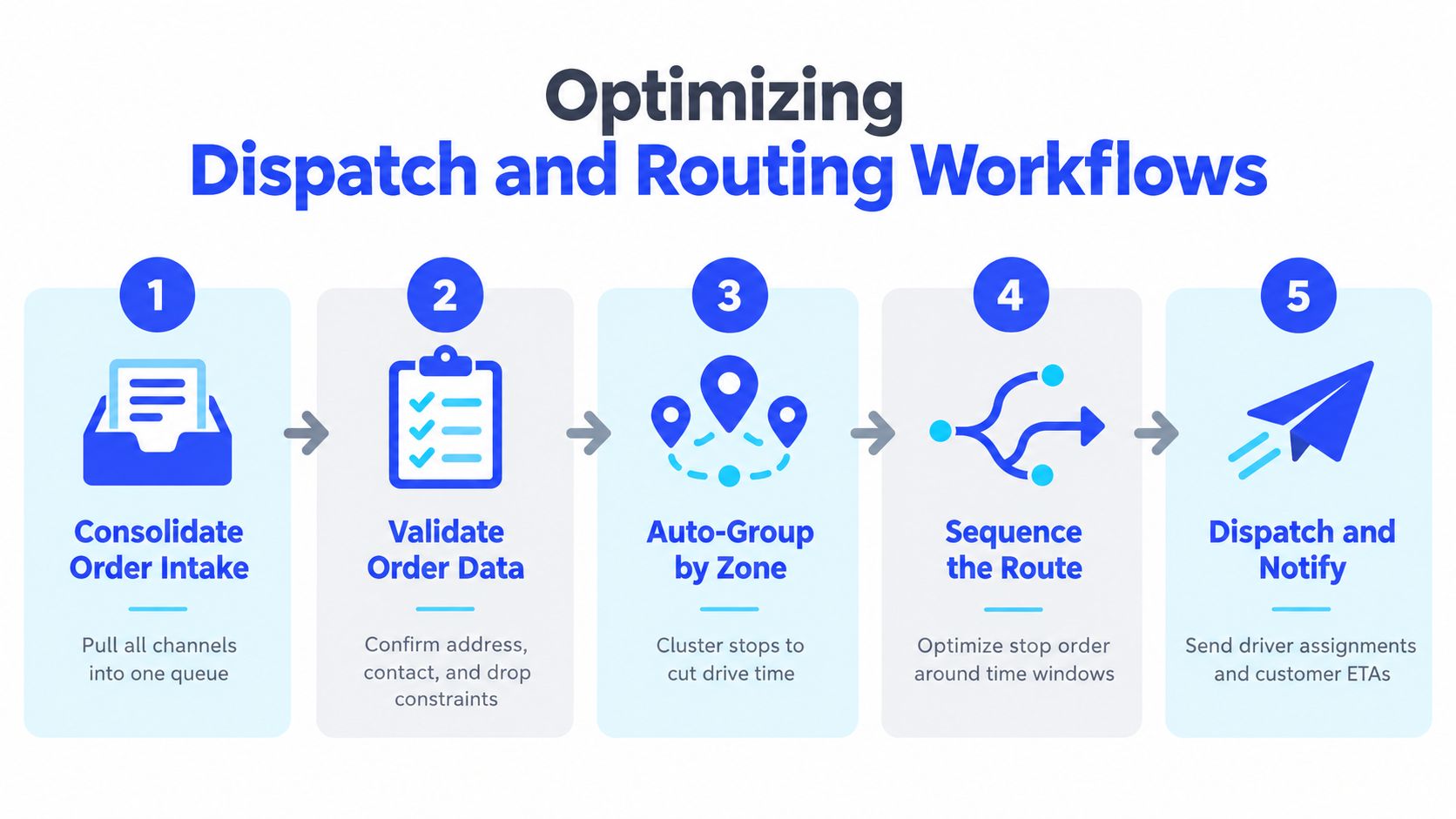
Use a consistent workflow for every order, regardless of where it originated.
-
Consolidate the queue. Bring spreadsheet imports, ecommerce orders, and API records into one planning view. Preserve the customer reference so the dispatcher can trace each stop back to its source.
-
Validate the stop. Check the address, contact details, delivery constraints, item requirements, and promised window before the order becomes eligible for route planning. Automatic geocoding should flag weak matches rather than placing a vehicle at the wrong point.
-
Correct the map position. A rural property, construction site, or rear access road may need a manual pin drop. Keep the correction attached to the stop so the driver sees the operational location, not only the postal address.
-
Assign the right depot and zone. Multi-depot boards should separate locations and operating days clearly. Zones and geofences help planners filter territories, review recurring work, and identify a route that has crossed into an inefficient area.
-
Check capacity before sequencing. Review item, weight, and volume totals against vehicle and driver constraints. An overload warning before dispatch is far cheaper than a late call from the road.
-
Optimize, then edit with judgment. Automatic sequencing can reduce unnecessary driving, but the dispatcher still needs to account for site access, loading order, driver familiarity, service time, and customer priorities. A mathematically short route can be operationally poor if the vehicle must unload heavy goods before reaching a narrow site.
Protect the promise before dispatch
Don’t release a route just because every order has been assigned. Read the route as a customer promise. Look for compressed time windows, long service requirements, difficult access, return-to-depot obligations, and stops that depend on a customer being present.
A good planning board exposes those risks before the driver loads. It also lets the dispatcher make a deliberate choice, such as moving a stop to another depot, splitting a run, changing the delivery window, or contacting the customer before dispatch.
Fleet managers planning lower-emission operations can also use Flex Electric’s last mile fleet electrification tips alongside route planning work. Vehicle choice, charging requirements, payload, and route length must fit the physical delivery model. Electrification doesn’t remove the need for sound sequencing. It makes capacity and planning discipline even more important.
Managing Driver Execution and Customer Visibility
The driver is where the planned experience meets the physical stop. A route can be well sequenced, but the customer still needs the driver to find the correct entrance, follow the drop instruction, record the outcome, and report an exception while the details are fresh.
A native driver app isn’t the only way to achieve that. A secure, PIN-protected browser link can work on a driver’s smartphone without a lengthy installation process. That approach is useful for subcontractors, seasonal drivers, and operations where one device may be used across routes. The important requirement is not the brand of device. It’s a consistent workflow with clear permissions and reliable event capture.
Make every stop state unambiguous
Use explicit states such as dispatched, en route, arrived, delivered, failed, and returned. Each state needs a source of truth and a transition rule. A driver tapping “arrived” should create a timestamped event tied to the correct stop, not a vague note that someone can interpret later.
Proof of delivery should match the goods and the dispute risk. Useful records can include:
- Sign-on-glass: Capture a recipient acknowledgement where a signature is required.
- Photographs: Show the placement or condition of goods when a visual record is appropriate.
- Reason codes: Distinguish customer unavailable, unsafe access, damaged goods, wrong address, and other outcomes.
- Driver notes: Record the context that a code alone can’t explain, especially for a complex site.
A vehicle breakdown can turn a reliable route into a customer-facing failure. Managers should have a clear escalation path for roadside problems, including access to SAAT Repairs Corp’s on-site semi repair guidance for fleets. The operational principle is simple: record the exception, protect the remaining route, and communicate a revised promise rather than leaving customers to discover the problem.
Treat tracking as state management
Tracking isn’t just a page with a moving vehicle icon. It depends on accurate live events, recalculated ETAs, and notifications that reflect what has happened. A study of last-mile logistics reported a correlation of r = 0.812 between real-time tracking facilities and customer satisfaction, while also identifying accurate live data, electronic proof of delivery, communication, and reverse logistics as positively related factors. The reported real-time tracking study indicates association rather than universal causation, so operators should validate results using their own support contacts, ETA accuracy, tracking usage, and post-delivery feedback.
Recalculate the ETA after route deviation, service-time overrun, skipped stop, or navigation change. Deduplicate notifications across email, SMS, and WhatsApp so the customer receives a coherent sequence rather than repeated alerts. Branded tracking pages should expose the current state, useful context, and proof of delivery after completion.
For an example of how customer-facing tracking can support this workflow, see Routelink’s follow-my-delivery guidance. The value comes from connecting the page to operational events, not from adding another communication channel in isolation.
Addressing Accessibility and Complex Drop Requirements
Fast delivery isn’t automatically a good delivery. A customer may need extra time to reach the door, a louder knock, a phone call instead of a text, or help moving a heavy item from the vehicle. A standard “leave safe” instruction can create efficiency for one household and a serious failure for another.
Recent UK evidence found that 20% of people reported an accessibility need they wanted to share with a parcel company, while 39% of people with an accessibility need said they were unable to share it. The 2025 Parcels League Table Report highlights the gap between offering a delivery service and capturing the information needed to complete the handover properly.
Capture only what the driver needs
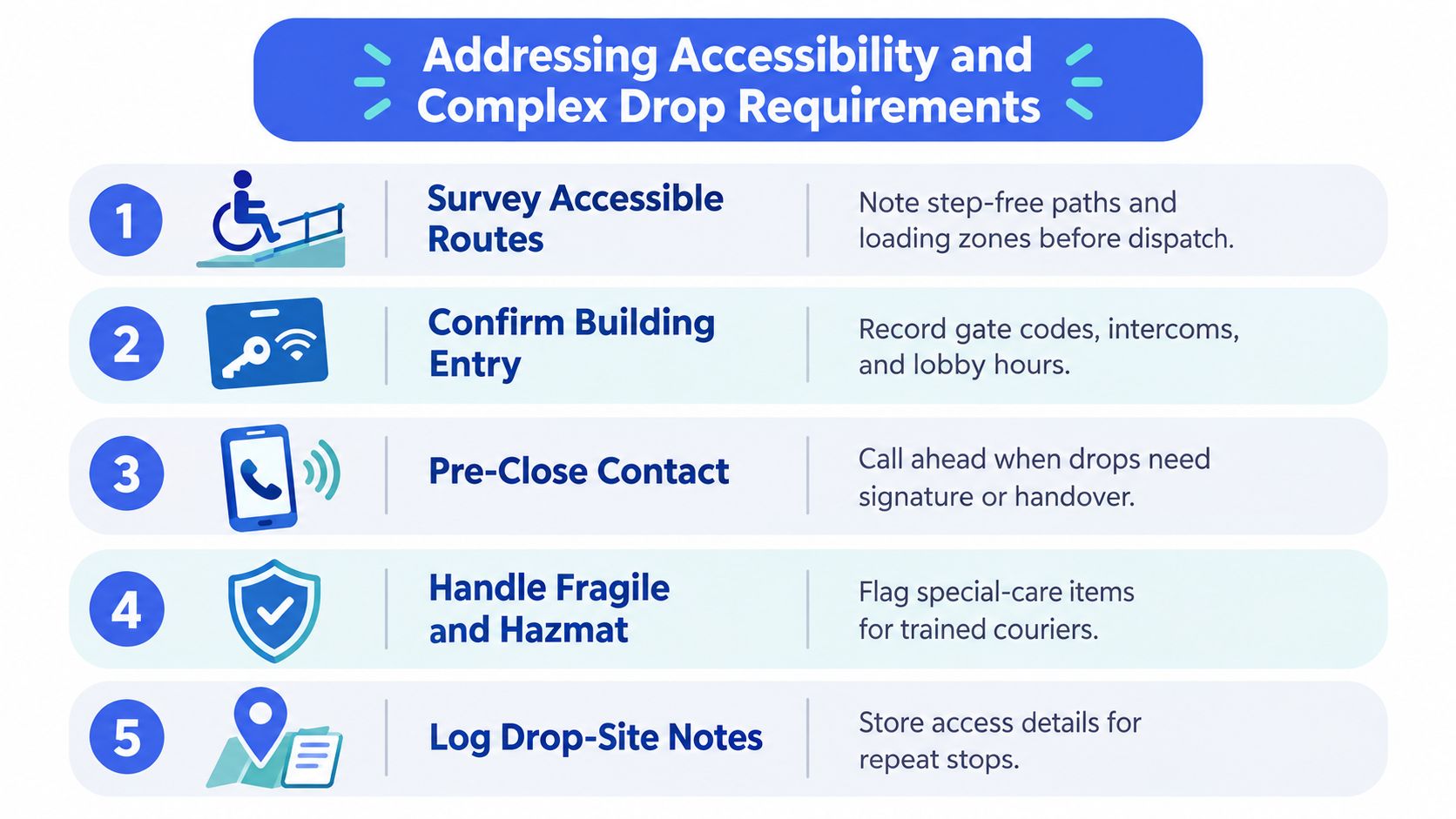
Accessibility information should be useful at the stop without exposing unnecessary sensitive details. Ask for an operational preference, such as “allow extra time,” “call on arrival,” “use rear entrance,” or “customer requires handover.” Avoid collecting medical information that the driver doesn’t need to complete the delivery.
Then place the preference where it will be seen at the right moment:
- At order intake: Offer clear options for contact, access, handover, and safe placement.
- On the route view: Display a short, prominent prompt beside the stop.
- Before arrival: Trigger a suitable call or message when the driver is close.
- During proof of delivery: Record whether the requested handover occurred or why it couldn’t.
- After the run: Separate accessibility-related failures from ordinary lateness.
This approach also works for heavy goods. A customer receiving firewood, appliances, aggregate, or furniture may need a specific drop zone, extra handling, or confirmation before unloading. The driver shouldn’t have to infer those conditions from a general delivery note.
Balance contactless convenience with human assistance
“Leave safe” policies reduce waiting and can help drivers complete straightforward stops. They aren’t appropriate for every property or customer. A business should define when a handover is mandatory, when a safe placement is acceptable, and what the driver must do if the requested method isn’t possible.
Measure failed handovers accurately. If a driver arrived within the window but couldn’t complete the delivery because the accessibility instruction was missing from the route, that isn’t the same failure as customer unavailability. Different causes require different fixes, and customers with high-effort delivery needs shouldn’t disappear inside a general failed-delivery statistic.
Adapting Operations for Specific Local Industries
The right delivery workflow depends on the product, vehicle, site, and handover. A route that works for boxed retail goods may be unsafe or commercially useless for bulk materials, chilled food, gas cylinders, or furniture.
| Local industry | Operational priority | Useful route and proof settings |
|---|---|---|
| Builders merchants and landscaping suppliers | Site access, unloading location, vehicle suitability, and delivery constraints | Zone-based planning, site notes, photos, recipient or site-manager acknowledgement |
| Cold chain food wholesalers | Tight receiving windows, load sequence, and temperature handling | Time-window rules, item-level requirements, exception reasons, delivery records |
| LPG and bottled gas distributors | Safe access, cylinder exchange, customer presence, and route continuity | Driver prompts, contact-before-arrival rules, failed-stop reasons, return records |
| Furniture and appliance retailers | Crew coordination, room placement, installation expectations, and property protection | Multi-person assignment, appointment windows, photos, signatures, damage notes |
Builders merchants often need the dispatcher to understand the site before the truck rolls. A postcode may locate the entrance but not the safe tipping area. Store gate instructions, loading restrictions, surface conditions, and contact details as stop-level information rather than leaving them in a salesperson’s inbox.
Cold chain planning needs a different discipline. The planner should sequence receiving appointments around the customer’s ability to accept the load, then give the driver the handling requirements that affect the stop. A late arrival isn’t the only risk. Poor loading order or an unclear exception process can also compromise the delivery.
Gas distribution adds safety and exchange complexity. The driver may need to confirm that the customer is present, record returned cylinders, and handle a failed stop without improvising. The best route isn’t necessarily the one with the shortest distance. It’s the one that respects safe handling, vehicle constraints, service time, and customer availability.
Furniture and appliance operations usually require more coordination at the doorstep. A two-person crew may need a different route template from a single driver, with longer service duration and stronger proof of placement or damage condition. The planning system should reflect that reality instead of treating every stop as a uniform pin on a map.
For each industry, configure zone groups, recurring route templates, capacity rules, driver prompts, and proof requirements around the physical work. Software should adapt to the operation’s constraints, not force every delivery into the same template.
Implementing a Delivery Management Platform
A delivery management platform only improves the customer delivery experience when the operating rules behind it are clear. Start with the workflow, not the software settings. Map how an order enters the business, who validates it, how the route is approved, what the driver records, and how exceptions reach the customer.
Use a controlled rollout
Begin by auditing the current process. List every intake source, manual handoff, spreadsheet, driver instruction, customer notification, and post-run report. Mark where duplicate entry occurs and where a dispatcher has to make a decision without enough information.
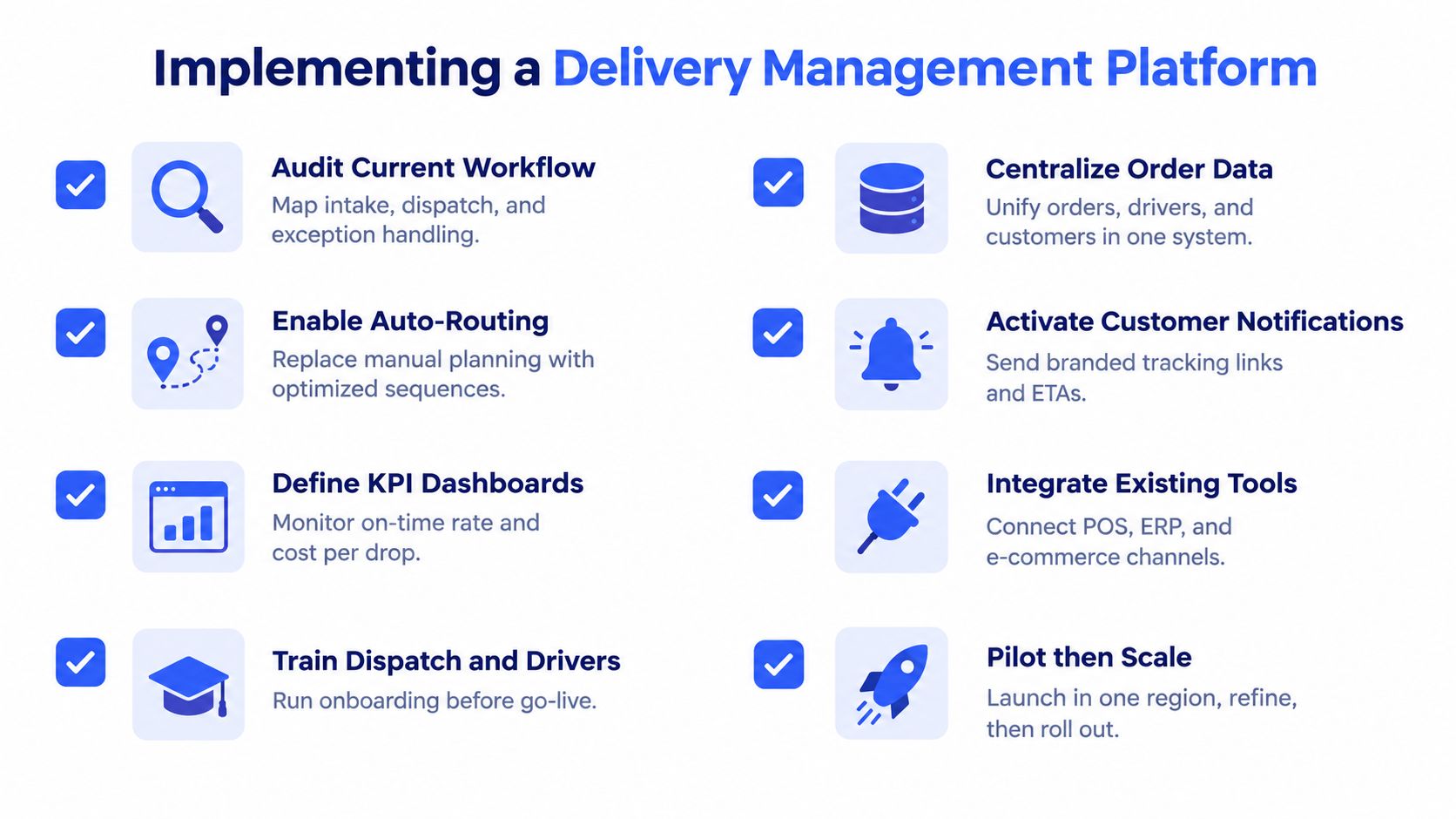
Then work through the implementation in an order that protects daily operations:
- Centralize order data. Import spreadsheets using a controlled template and connect ecommerce, ERP, CRM, or API sources where appropriate.
- Set geocoding tolerances. Flag weak address matches for review and require a valid map position before auto-planning.
- Configure depots and zones. Separate planning boards by location and operating day, then create practical territory views.
- Define capacity rules. Use item, weight, volume, vehicle, and crew constraints to identify overloaded routes before dispatch.
- Deploy driver links. Give drivers secure browser access, clear stop states, navigation, and proof-of-delivery prompts.
- Configure customer messages. Set event-based notifications for scheduled, en-route, delivered, and failed stops. Keep the wording specific and avoid duplicate alerts.
- Set the KPI baseline. Track on-time-in-window percentage, failed-delivery rate, ETA accuracy, order accuracy, and notification engagement.
- Pilot before scaling. Start with one depot, route group, or service area. Review the first runs, correct rules, then expand to other teams.
Audit the first runs closely
The first operational reviews should focus on exceptions rather than average performance. Compare planned and actual arrival times, inspect stops with manual pin corrections, review overloaded routes, and check whether drivers used the correct failure reasons. PDF trip sheets provide a useful backup for depot reviews and conversations with drivers who had limited connectivity.
A platform such as Routelink can combine order intake, geocoding, multi-depot route planning, browser-based driver dispatch, branded customer tracking, notifications, proof of delivery, and post-run analytics in one web-based workflow. The implementation still depends on disciplined data ownership and clear operating rules. Technology can expose a missing address or infeasible route, but a person must decide how to correct it.
Use the delivery management system implementation guidance to turn those controls into a repeatable rollout plan. The finished process should make it easier for dispatchers to protect realistic promises, for drivers to complete complex stops, and for customers to understand what is happening without calling the depot.
Routelink brings order intake, route optimization, driver dispatch, live customer tracking, notifications, proof of delivery, and post-run analytics into one web-based platform for local fleets. Visit Routelink to review how it can support reliable, accessible, and practical delivery operations across your depots and routes.