Temperature Controlled Delivery: A Practical 2026 Guide — Routelink
Master temperature controlled delivery in 2026 with this clear guide covering cold chain basics, equipment, regulations, KPIs, and how Routelink fits in.
13 August 2026 · Routelink Team
Temperature Controlled Delivery: A Practical 2026 Guide
Master temperature controlled delivery in 2026 with this clear guide covering cold chain basics, equipment, regulations, KPIs, and how Routelink fits in.
Table of Contents
- The risk sits in the handoff, not just the truck
- Why the category has become mainstream
- The Cold Chain Concept Explained
- The useful mental model
- The three bands operators manage
- What regulation and monitoring add
- Active cooling and passive protection do different jobs
- Monitoring is the proof layer
- Capture and plan before the vehicle moves
- Dispatch and notify as one control loop
- Deliver with evidence, not memory
- Passive packaging can buy you time
- Winter can be a temperature problem too
- A short playbook for the most common failures
- The KPIs that help
Why Temperature Controlled Delivery Matters in 2026
A chilled order can look fine at pickup and still fail by the time it reaches the customer. The driver was delayed, the handoff dragged on, the package warmed up, and now everyone is trying to explain where the chain broke. That is the key pressure point in temperature controlled delivery, the route, the timing, the handoff, and the proof that the product stayed in range all the way through.
The good news is that this is no longer a niche issue for a few pharmaceutical fleets. One neutral market estimate puts the temperature-controlled last-mile delivery services market at USD 11.1 billion in 2025, rising to USD 12.4 billion in 2026 and projected to reach USD 35.8 billion by 2036, which implies 11.2% CAGR over 2026 to 2036, with USD 23.4 billion in incremental revenue growth over the period Future Market Insights market estimate. That scale shows operators are building a discipline around risk, not guessing their way through it.
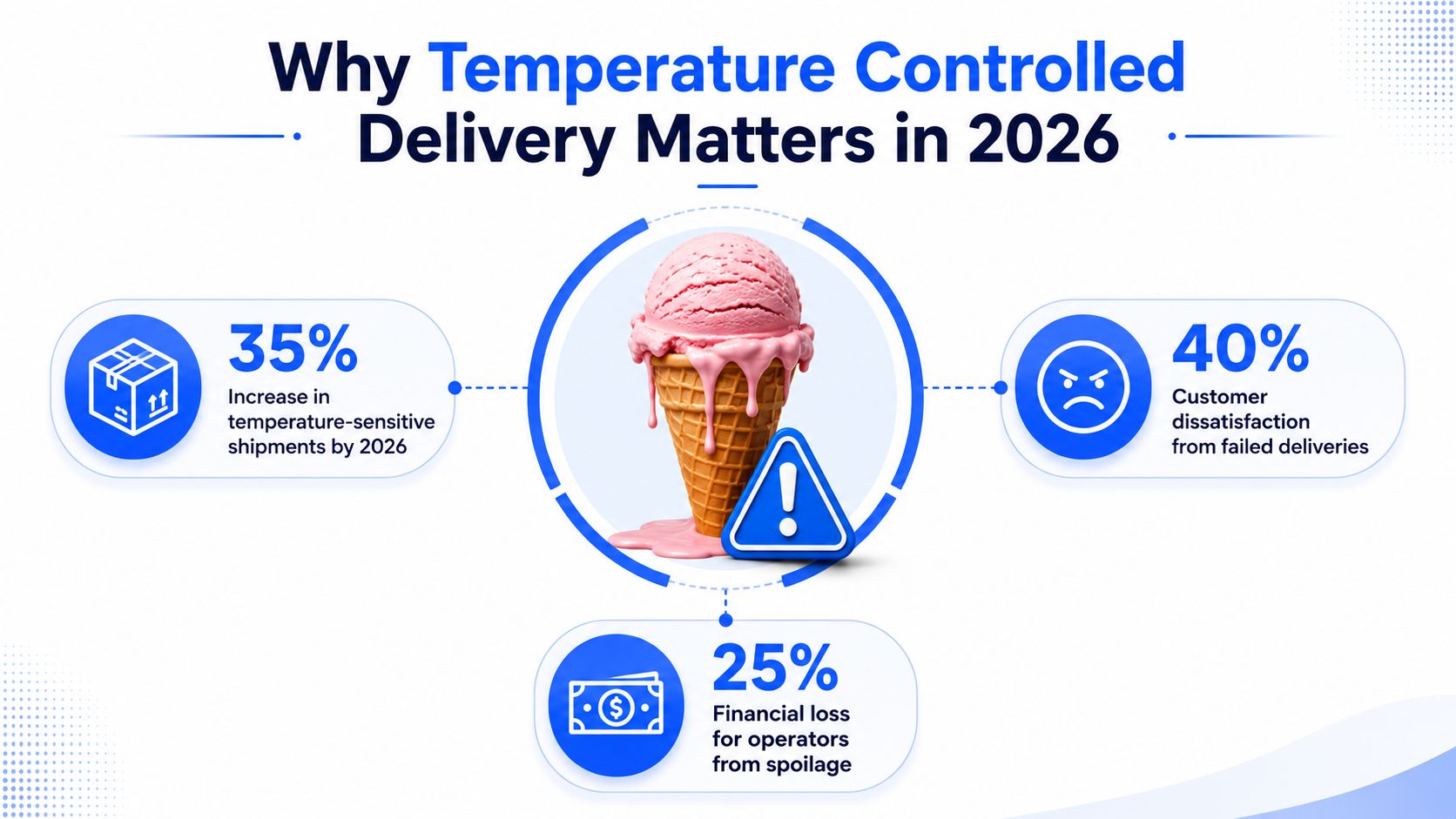
The harder part is that the last mile is where temperature-sensitive goods face dwell time, route delays, and failed handoffs. Growth is also uneven, with faster expansion in India at 13.4% CAGR and China at 12.6% CAGR, which reflects how urban demand for pharmaceuticals, fresh food, and specialty goods is pulling this model forward in Asia Future Market Insights market estimate. If you manage routes, drivers, or customer promises, this now reaches into your daily work.
The risk sits in the handoff, not just the truck
A peer-reviewed review explains why the industry moved from the older term cold chain to the broader idea of temperature-controlled logistics. Product needs vary across ambient 20°C to 25°C, refrigerated 2°C to 8°C, and cryogenic below 0°C to as low as −150°C peer-reviewed review. That range matters because the shipment does not just sit in a vehicle. It moves through doors, stairs, waiting rooms, and people.
The same review cites supply-chain survey data showing that among temperature-sensitive products shipped, 51% were ambient, 31% refrigerated, and 17% frozen, while 32% should not be allowed to freeze peer-reviewed review. That mix is why one delivery setup rarely fits every product line. A meal kit, a vaccine, and a biological sample may all need different handling even if they travel on the same van route.
Why the category has become mainstream
Many new operations managers get surprised by the scale. The market is large enough to justify dedicated routing rules, vehicle types, and monitoring workflows rather than ad hoc delivery. The market estimate above shows a sector growing into a structurally important logistics category, not a special case.
Practical rule: if a product can be damaged by time as much as by heat, the route plan matters as much as the box.
For a working example of the kind of operational control healthcare teams often need, see this medical courier app guide. The rest of this article breaks the topic into the pieces that matter in real operations, what the temperature bands mean, what tools protect them, how the workflow should run, and when the best fix is to rethink the delivery model itself.
The first failure usually does not look dramatic. A driver misses a window, leaves the parcel at reception, or waits too long for a signature, and by the time the complaint lands in your inbox, nobody can say exactly where the chain broke. That is why temperature controlled delivery has become an operations problem, not just a packaging problem.
The Cold Chain Concept Explained
A hot meal leaving a kitchen helps explain the idea. It is fine at the pass, still fine in the car for a short time, and suddenly not fine if it sits too long at a doorstep. Temperature controlled delivery works the same way, only the product is not dinner, it might be a biologic, a dairy product, or a frozen meal with a narrow stability window.
The useful mental model
The older phrase cold chain suggests one continuous refrigerated pipe. Real life is messier. The delivery chain includes pickup, packing, vehicle loading, route time, parking, handoff, and sometimes customer delay. Every one of those steps can move the product away from its required band.
That is why the broader phrase is better. It includes ambient stability, refrigeration, and deep-cold transport, not just a chilled truck. The product’s job is to stay within its own range, not to become as cold as possible.
The three bands operators manage
The three core bands are easy to remember:
- Ambient, usually 20°C to 25°C, for products that need stability without refrigeration.
- Refrigerated, usually 2°C to 8°C, for goods that must stay cool but not freeze.
- Cryogenic, below 0°C and down to roughly −150°C, for highly specialized shipments peer-reviewed review.
That same review also shows why the mix is not simple. Most temperature-sensitive shipments in the cited survey were ambient, not refrigerated, which is a reminder that “temperature controlled” does not automatically mean “cold” peer-reviewed review.
A shipment fails when the environment changes faster than the product can tolerate, not when the label says “cool.”
Food handling guidance makes the timing point very clear. Hong Kong’s Centre for Food Safety says hot food should stay above 60°C, cold food at or below 4°C, and prepared food held at room temperature for more than four hours should be discarded. If it has been at room temperature for less than two hours, it can be refrigerated for later use within the four-hour limit Centre for Food Safety. That is the part many people miss. Temperature control is about both the band and the clock.
Product Types and the Temperature Ranges They Require
A common mistake is treating every sensitive product as if it needs the same chilled box. That is how teams end up over-engineering some routes and under-protecting others. The smarter approach is to match the product to the band, then design the workflow around that band.
| Product Category | Required Range | Governing Reference |
|---|---|---|
| Fresh produce | Often ambient or refrigerated, depending on item and shelf life | Product-specific handling rules, see general temperature bands in peer-reviewed review |
| Dairy | Usually refrigerated | General refrigerated band in peer-reviewed review |
| Frozen meals | Frozen conditions, with protection from thawing | Frozen shipment mix discussed in peer-reviewed review |
| Pharmaceuticals | Often refrigerated, ambient, or product-specific narrow bands | Temperature ranges in peer-reviewed review |
| Vaccines | Commonly refrigerated, with strict excursion control | WHO transport guidance for sensor control WHO model guidance |
| Biological samples | Product-specific, often narrow controlled ranges | General transport control principles in WHO model guidance |
| Meal kits | Often refrigerated, sometimes ambient components in the same order | Temperature bands in peer-reviewed review |
| Chocolate and specialty food | Usually ambient or protected from heat excursions | Ambient band in peer-reviewed review |
What regulation and monitoring add
ISO 23412 defines indirect, temperature-controlled refrigerated delivery services for refrigerated parcels containing temperature-sensitive goods in land transportation ISO 23412. That wording matters because it says the delivery system has to preserve the environment around the parcel through handling, not just cool the vehicle.
WHO model guidance is equally direct. Vehicle control sensors should be accurate to ±0.5°C or better, located in the worst-case temperature zones, and independent from the monitoring system WHO model guidance. In plain terms, one dashboard reading from the cab does not prove the parcel stayed safe.
Equipment Packaging and Monitoring Tools
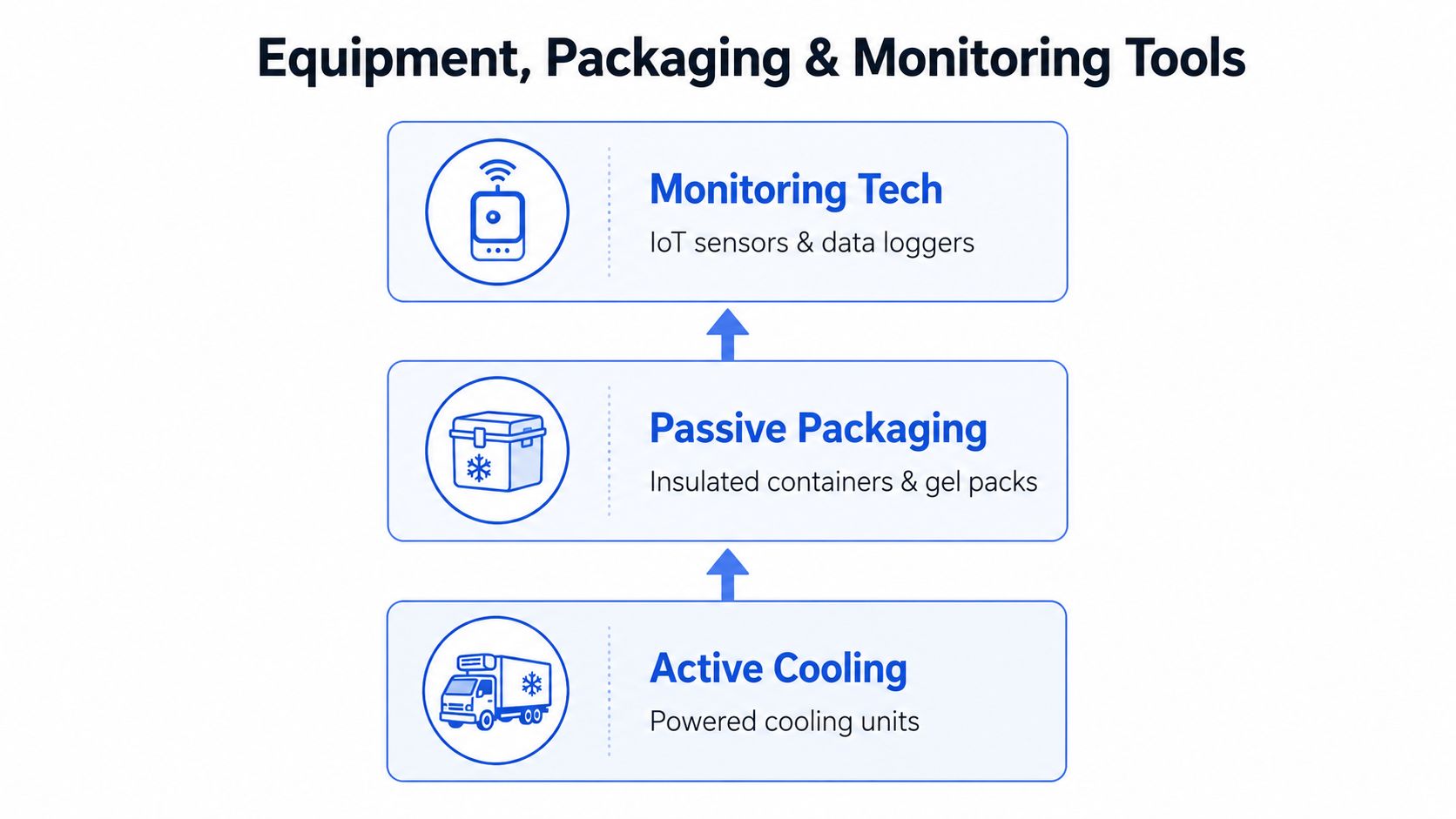
The toolset for temperature controlled delivery has three layers, and each one solves a different problem. Cooling holds the environment, packaging slows heat transfer, and monitoring tells you when the plan is slipping. If you treat them as interchangeable, you will overbuy one layer and neglect another.
Active cooling and passive protection do different jobs
Active cooling includes reefer vehicles, refrigerated vans, and multi-temperature compartments. These are the workhorses for longer routes or shipments that cannot tolerate much drift. They are not the only answer, but they are the most direct one when route time is long or handoff conditions are messy.
Passive protection covers insulated boxes, phase-change materials, gel packs, and validated thermal containers. They work like a battery for temperature. They do not create cold, they store it and slow the rate at which the parcel moves out of range.
The practical decision is route length and risk. A short urban drop with a predictable handoff may do fine with validated passive packaging. A longer run with repeated stops usually needs active support. The wrong choice shows up as either unnecessary cost or a preventable excursion.
Monitoring is the proof layer
A USB temperature logger is the simplest way to think about this. It is the black box for a parcel. It records what happened, even if the driver, dispatcher, and customer remember the story differently.
That is why calibration and placement matter so much. A sensor mounted in the wrong place can give a comforting number that has nothing to do with the product. The WHO guidance above, with sensors in the worst-case zone and accurate to ±0.5°C or better, is the operational standard to aim for WHO model guidance.
If you are building a monitoring stack, this delivery tracking software guide is a useful companion for understanding how live visibility, alerts, and customer communication fit together. The key point is simple. Monitoring only helps if someone can act on it fast enough.
Operating the End-to-End Workflow
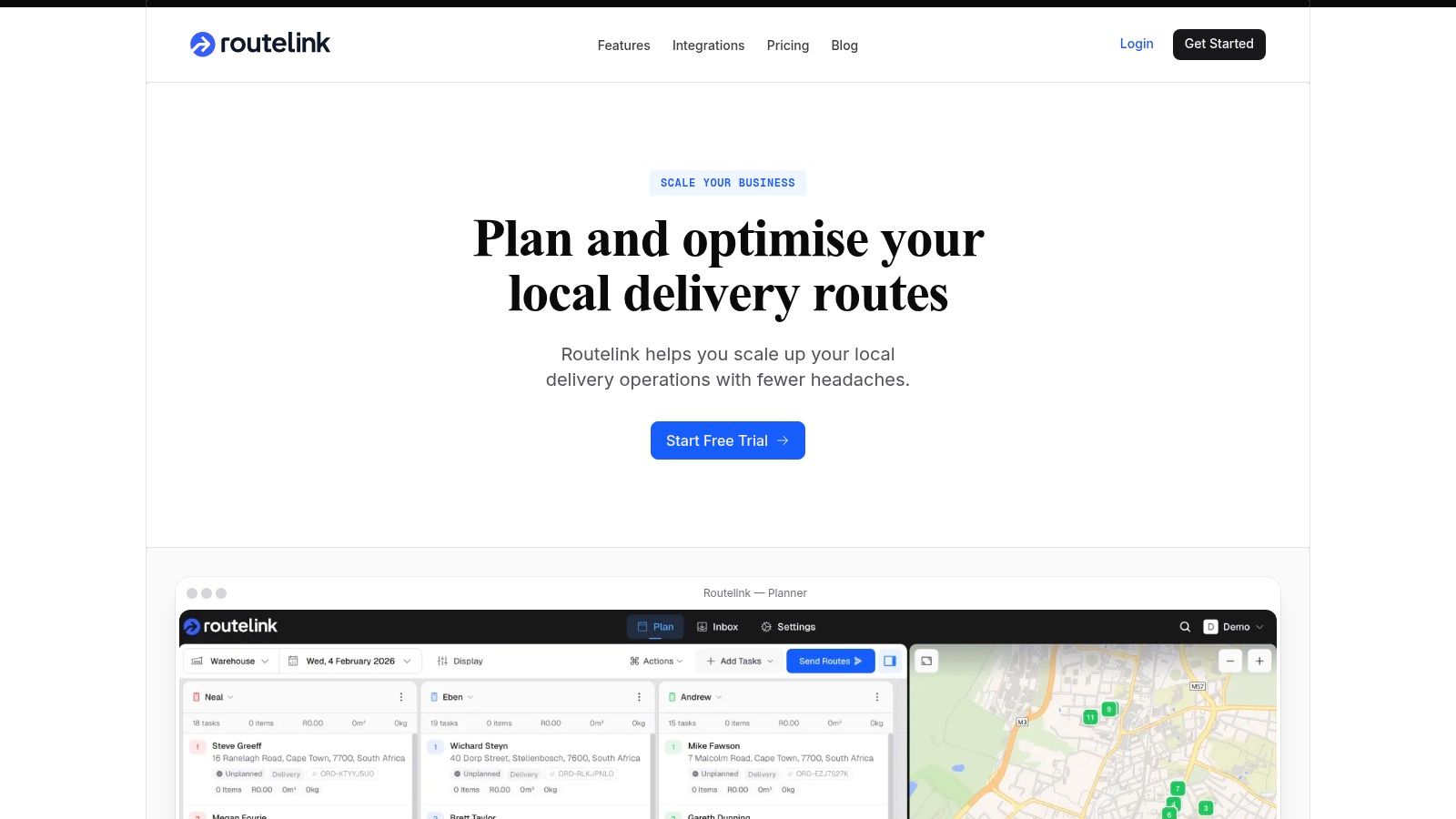
Temperature control breaks most often at the seams between systems. Orders arrive in one place, routing happens in another, drivers use a third tool, and customers get told something different by each screen. A stable operation fixes that by making the workflow consistent from order capture through proof of delivery.
Capture and plan before the vehicle moves
The first job is capture. Every order needs its required temperature band attached to it before planning starts, whether the job came from Shopify, WooCommerce, an ERP, or a CSV import. If the product is mislabeled at this stage, every downstream decision is compromised.
Then comes plan. A good route plan respects time windows, product compatibility, vehicle capacity, and any driver certifications that apply. The goal is not the shortest route on paper, it is the route most likely to keep the product safe in real traffic and real weather.
Dispatch and notify as one control loop
Dispatch should be frictionless for the driver. A PIN-protected link is better than forcing a new app download during peak periods, especially when subcontractors or seasonal drivers are involved. The fewer setup barriers there are, the faster the route can go live.
Notify is where most operators underestimate risk. Live branded tracking, SMS, email, and WhatsApp updates do not just improve service, they help you surface delays before they become temperature problems. If traffic or a missed stop is going to push a delivery past its thermal budget, the customer should hear about it early.
For route-building logic that reduces unnecessary exposure time, see this route optimization for last mile delivery guide.
Deliver with evidence, not memory
The last step is deliver. A signed receipt is useful, but temperature-sensitive shipments usually need more evidence than that. Sign-on-glass e-signatures, photos, and optional temperature readings at the door give you a record of what happened at the handoff.
Operational rule: if no one can prove what happened at delivery, the chain did not really finish.
That is the standard worth aiming for. The customer gets clarity, the dispatcher gets traceability, and the operation gets a record it can learn from.
Rethinking the Delivery Model Itself
Many teams reach for a bigger refrigerated fleet when the core problem is the route model. That is an expensive reflex. In remote or low-infrastructure areas, the bigger blocker is often unreliable electricity, limited storage and transport capacity, long routes, fragmented governance, and shortages of trained personnel 2026 vaccine cold-chain review.
Passive packaging can buy you time
That review points to a useful contrarian answer. Sometimes the best fix is validated passive packaging that extends the stable transit window, rather than adding more active cooling everywhere. When the route is short, the handoff is controlled, or the demand spike is temporary, that approach can be more practical than a dedicated reefer fleet.
WHO also has guidance on the Controlled Temperature Chain approach, which allows some licensed products to tolerate a defined departure from traditional refrigeration rules in specific use cases WHO CTC guidance context in the review. That does not mean you relax standards casually. It means the delivery model should match the product’s validated stability profile.
Winter can be a temperature problem too
Temperature controlled delivery is not only about keeping things cold in summer. Freezing weather can damage medical specimens and pharmaceuticals that need a narrow regulated range, and some shipments need to be kept warmer, not colder winter delivery guidance. That is why heating, ambient stability, and pre-conditioning belong in the same conversation as refrigeration.
The point is flexibility. More refrigerated vehicles help in some markets, but they will not solve every excursion. Better route design, validated packaging, and the right thermal strategy for the product often solve more problems for less cost.
Troubleshooting Excursions and the KPIs That Matter
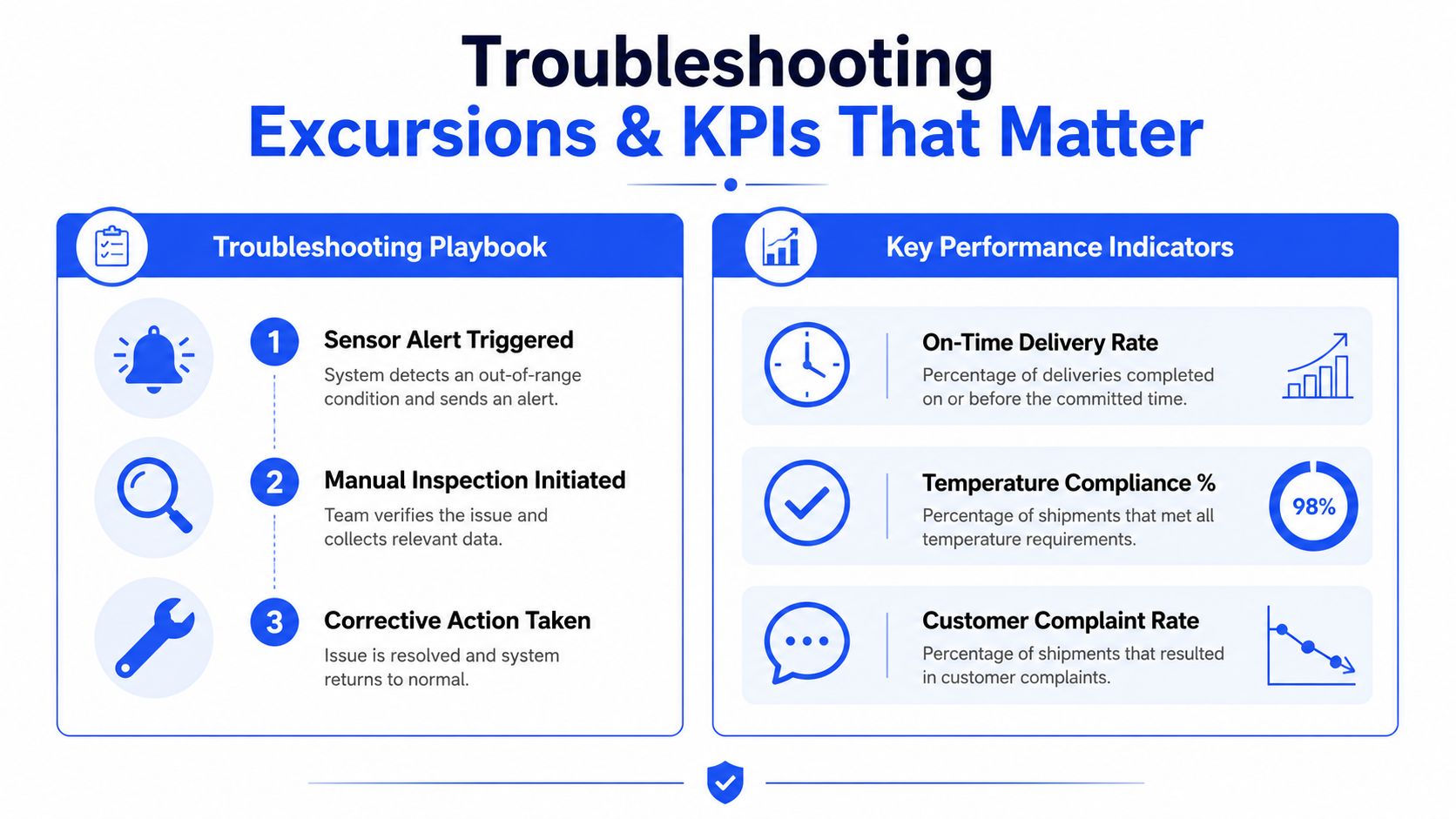
Even a good operation gets exceptions. What separates a controlled network from a messy one is how fast the team sees the problem, checks the evidence, and fixes the root cause. Most failures fall into the same three buckets.
A short playbook for the most common failures
- Sensor reading does not match reality. Check placement first, then calibration, then logger battery. A bad reading is often a bad sensor position, not a failed shipment.
- A route delay eats the thermal budget. Use live telemetry to alert the customer, then reroute or escalate before the shipment crosses its safe limit.
- The recipient is not available. Require a signature, define a contact window, or hold the parcel in a temperature-stable pickup point until handoff can happen safely.
The first mistake many teams make is treating every alarm as a product failure. Often it is a process failure, and the fix is operational, not chemical.
The KPIs that help
An operations lead does not need a giant dashboard. A small one is better, as long as it tracks the right things.
- Excursion rate tells you how often product conditions slip.
- Mean dwell time at the door shows where handoff risk is accumulating.
- On-time performance reveals whether routing is protecting the thermal window.
- Wastage shows the cost of failure in plain terms.
- Customer complaints linked to temperature flags the customer experience side.
- Cost per temperature-controlled stop helps you compare delivery models without guessing.
If one metric keeps moving in the wrong direction, look at the workflow before you blame the packaging. A late route, a weak handoff, or a sensor in the wrong zone is often the issue.
Bringing It All Together
The simplest decision framework is also the one often skipped. Before you add a new sensitive product, answer four questions. What range does it require, how long can it tolerate being out of range, where is the worst-case zone in our vehicle or packaging, and what proof will we give the customer at delivery?
Those four questions keep the conversation grounded in operations instead of guesswork. They also force a clear choice between active cooling, passive packaging, route redesign, and proof-of-delivery controls.
The market context matters here too. This is a growing global category, and the biggest risks still sit in dwell time and failed handoffs Future Market Insights market estimate. That is why the winning setup is rarely one single tool. It is the combination of packaging, routing, monitoring, and evidence at delivery.
For small and mid-sized operators, that combination is more accessible now than it used to be. You do not need to own a full refrigerated fleet to run a professional operation. You need a workflow that treats temperature as part of the route, the clock, and the handoff.
If you are building or tightening a temperature-sensitive delivery operation, Routelink gives you the workflow discipline to capture orders, plan routes, dispatch drivers, notify customers, and collect proof of delivery in one place. Visit Routelink to see how a cleaner route process can support temperature controlled delivery without adding unnecessary complexity.