Cheapest Cargo Van: A Smart Buyer's Guide — Routelink
Find the cheapest cargo van for your delivery business. Compare new vs used vs lease, upfit costs, and operating strategies that lower per-mile expenses.
27 August 2026 · Routelink Team
Cheapest Cargo Van: A Smart Buyer’s Guide
Find the cheapest cargo van for your delivery business. Compare new vs used vs lease, upfit costs, and operating strategies that lower per-mile expenses.
You’re comparing a low-priced full-size work van with a compact cargo van that costs more, and the cheaper option looks like the obvious choice. Then the routes start. The full-size van carries empty air, burns more fuel between dense stops, needs heavier tires, and costs more to equip. The compact van may have cost more at purchase, but it can deliver each order at a lower operating cost.
That’s the problem with shopping for the cheapest cargo van by sticker price alone. There are two different definitions of “cheap”: the lowest acquisition price and the lowest cost per completed delivery. A fleet operator needs the second answer.
Table of Contents
- Why the Cheapest Cargo Van Depends on Your Route
- What Actually Drives Cargo Van Pricing
- New Versus Used Versus Lease for Delivery Fleets
- Right-Sizing Your Van for the Routes You Run
- Upfit, Fuel, and Maintenance Costs the Sticker Hides
- Where the Best Bargains Actually Hide
- Negotiation and Financing Moves That Lower the Total Bill
- Cutting Per-Delivery Costs Through Smarter Operations
Why the Cheapest Cargo Van Depends on Your Route
A parcel operator on dense urban routes should not shop like an appliance hauler or regional parts distributor. Small packages, frequent stops, and unused cargo volume can turn a full-size van into an expensive storage box on wheels. The right purchase starts with the work the vehicle must perform each day.
The cheapest cargo van is the one that produces the lowest cost per completed delivery, not necessarily the one with the lowest badge price. Fuel, tires, insurance, labor, maintenance capacity, downtime, and working capital all affect the return from the asset. The purchase price is only the first line of the operating statement.
Separate purchase price from delivery cost
Lowest acquisition price is the smallest amount required to obtain the vehicle. In the U.S. new-vehicle market, the Chevrolet Express Cargo Van and GMC Savana Cargo Van each start at $44,595, while the Ram ProMaster Cargo Van starts at $48,965, according to current U.S. light commercial vehicle market pricing.
Lowest cost per delivery measures the vehicle after it enters service. Include fuel, maintenance, tires, depreciation, financing, insurance, downtime, and completed stops. A van with a higher MSRP can still cost less per delivery when its capacity matches the route and avoids carrying unused weight and volume.
Practical rule: If you regularly use only part of the cargo area, do not pay to operate the entire vehicle.
Build the comparison from operating requirements:
- Record the heaviest load, largest item, daily miles, stop count, and loading method.
- Choose the smallest van that meets those requirements without overloading.
- Combine the vehicle, upfit, financing, fuel, tires, maintenance, and downtime in one cost view.
- Divide that cost by completed deliveries, not by the number of vehicles in the fleet.
Route density should shape the decision. A compact van may serve frequent urban stops efficiently, while a larger vehicle can make sense when loads are bulky, routes are longer, or deliveries are less concentrated. Right-sizing also limits unnecessary upfit, fuel, and maintenance exposure.
Evaluate the full operating bill before accepting a low advertised price. Acquisition method, route fit, equipment, financing, inventory source, and daily operating discipline determine whether the van is cheap.
What Actually Drives Cargo Van Pricing
Cargo van prices reflect more than cargo volume. Manufacturers segment platforms by size, drivetrain, safety equipment, emissions compliance, body construction, fleet demand, and expected resale value. That’s why two vans with similar exterior dimensions can carry very different price tags.
The current U.S. floor for mainstream full-size cargo vans is clear. The Chevrolet Express Cargo Van and GMC Savana Cargo Van begin at $44,595, and the Ram ProMaster Cargo Van begins at $48,965. Across the broader listed cargo-van market, new-vehicle MSRPs range from $44,595 to $63,475, as documented by Coherent Market Insights.
A base trim often excludes the equipment that makes a van usable on delivery routes. Shelving, partitions, reinforced flooring, ladder systems, upgraded suspension components, telematics, and cold-weather equipment all change the final acquisition cost. The buyer who compares a bare van with a fleet-ready van is comparing two different assets.
The platform matters
Integrated cargo vans use a body and chassis designed as one commercial platform. Chassis-based configurations offer different body and upfit choices, but the added flexibility can introduce more equipment decisions, more weight, and more opportunities to overspend. Passenger and cargo variants may share parts and mechanical systems, which can support parts availability and technician familiarity, while commercial-specific components can raise service costs.
Fleet and retail channels also produce different prices. A commercial buyer may receive fleet incentives or destination adjustments that don’t appear in a consumer-facing advertisement. A retail buyer may get more trim and comfort equipment, but those features don’t automatically improve route economics.
Structural pricing drivers at a glance
| Driver | What It Changes | Typical Price Impact |
|---|---|---|
| Base trim versus work package | Cargo protection, storage, comfort, and durability | Raises the final bill as equipment is added |
| Full-size versus compact platform | Payload, interior volume, fuel use, tires, and service needs | Full-size platforms generally require more operating budget |
| Integrated body versus flexible chassis | Upfit choices and body configuration | Changes both purchase complexity and usable capacity |
| Fleet specification | Incentives, standardized equipment, and service terms | Can reduce acquisition friction for qualified buyers |
| Emissions and safety equipment | Powertrain hardware, compliance, and driver-assistance systems | Adds cost but may support access and compliance |
| Passenger-platform sharing | Parts commonality, resale demand, and comfort features | Can affect repair availability and residual value |
Older pricing shows how far the market has moved in nominal terms. Historical Dodge Ram Van listings show cargo vans starting at $12,951 for a 1994 Ram Van 150 and reaching $18,524 for a Ram Van 350 Maxi. By 1997, the Ram B1500 SWB Cargo Van was listed at $16,845, while the larger B2500 Maxi Cargo Van was listed at $19,360, according to the Dodge Ram Van historical price listing. The change reflects larger platforms, safety and emissions requirements, and higher-spec commercial equipment.
New Versus Used Versus Lease for Delivery Fleets
The right acquisition path depends on three questions: how much cash leaves the business today, how much monthly pressure the vehicle creates, and what flexibility remains when the route changes. A new van offers the cleanest history and strongest warranty position. A used van can preserve capital. A lease can protect cash flow, but it shifts risk into mileage, wear, and contract terms.
Consider this planning example. A new full-size van costs $42,000, a used van that’s 36 months old costs $26,000, and a 36-month lease costs roughly $850 per month. These figures are a decision model, not a market quote, so compare the full contract and operating assumptions before signing.
Compare the cash pattern
| Dimension | New | Used, 3 years old | Lease, 36 months |
|---|---|---|---|
| Cash out today | Highest purchase commitment | Lower purchase commitment | Usually lower initial cash requirement |
| Monthly operations pressure | Loan payment plus operating costs | Loan payment plus repair reserve | Contract payment plus operating costs |
| Warranty position | Strongest factory coverage | Remaining coverage varies | Often supported by contract or manufacturer terms |
| Downtime exposure | Usually lower at the start | Higher mechanical uncertainty | Depends on lease rules and included service |
| Exit value | Owner retains resale value | Less remaining depreciation than new | Return or purchase decision follows contract |
| Main risk | Depreciation and capital tied up | Hidden repairs and poor history | Mileage penalties, damage rules, and limited flexibility |
A new van suits a scaling fleet that can’t afford an unexpected repair event during expansion. Used works for a cash-strapped startup with a repair reserve and access to a trusted inspector. Leasing fits a stable operation that values predictable replacement cycles and can forecast mileage accurately.
The cheapest option on paper can change once you include downtime and exit value. A used van with poor maintenance records can consume the acquisition savings quickly. A lease that restricts mileage can punish a route that grows faster than expected. Before committing, operators should also understand the revenue, cost, and compliance questions covered in this cargo van business guide.
Don’t compare a purchase price with a lease payment. Compare the total cash required to complete the same work over the same operating period.
Right-Sizing Your Van for the Routes You Run
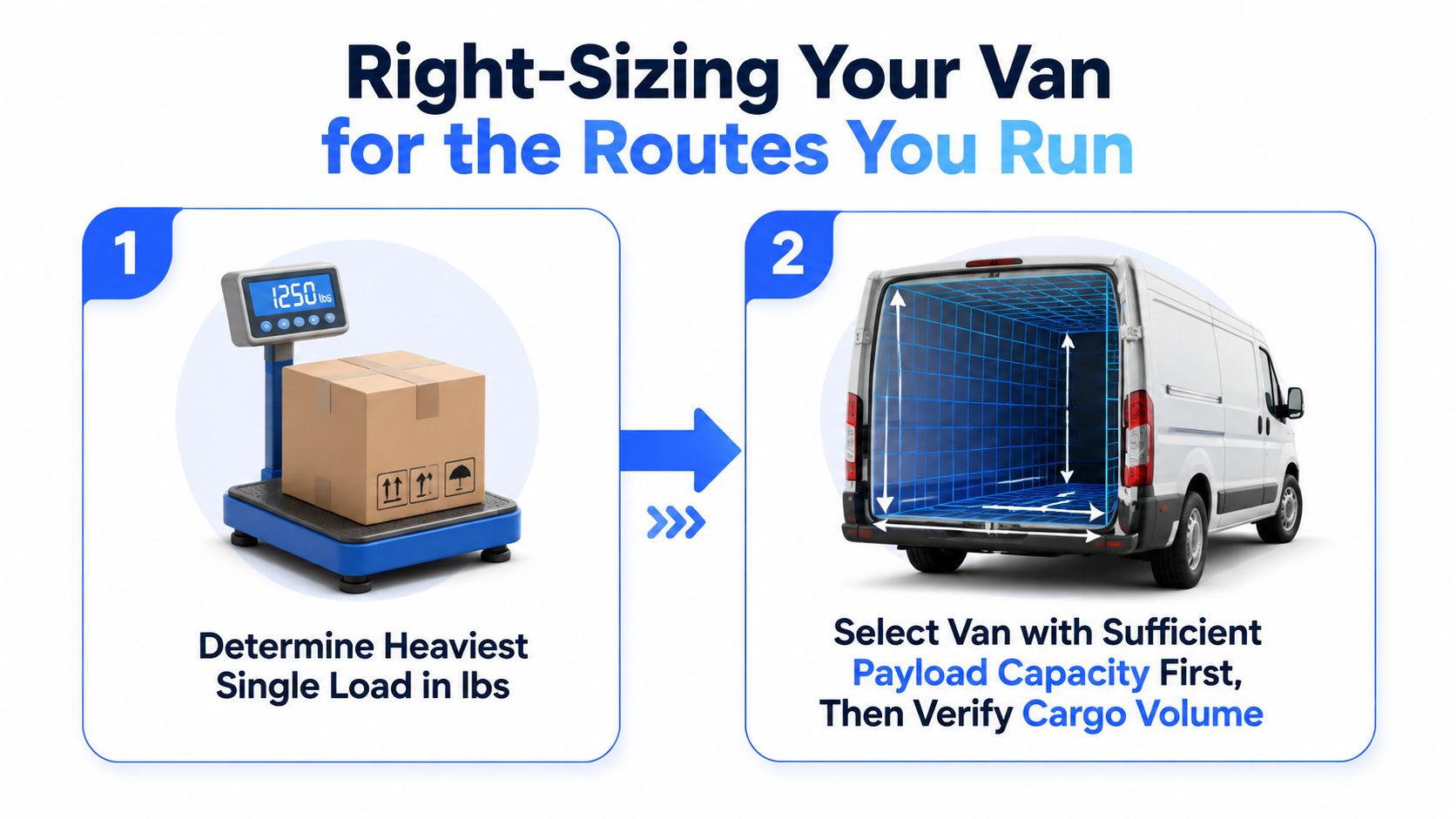
Most small delivery businesses choose cargo volume first. That’s backwards. Payload comes first, because a van that fits every box but exceeds its legal or practical weight limit is unusable.
Use a three-stage check:
- Find the heaviest single load, including the driver, fuel, shelving, tools, and other equipment.
- Confirm the van’s usable payload after the planned upfit.
- Verify interior length, door opening, step-in height, and cubic capacity.
Match the vehicle to the delivery profile
Parcel and envelope routes under 1,500 lb daily usually favor compact cargo vans. Dense urban routes benefit from a smaller turning circle, easier parking, lower tire demand, and less unused volume. The Ford Transit Connect has been listed at a starting MSRP of $30,760 and is rated up to 24 mpg city and 28 mpg highway with the turbo 2.0L engine, according to MotorVerso’s cargo-van comparison.
Mid-weight distribution runs between 1,500 and 3,000 lb need a closer payload review. A mid-size configuration can work when the route needs more length and shelving but doesn’t justify a heavy full-size platform. Check the payload label after every upfit, because storage hardware reduces the capacity available for deliveries.
Bulk or appliance hauls above 3,000 lb generally require a full-size solution, stronger load support, and more careful loading procedures. Choosing a compact van because it’s cheaper creates payload risk and can force split trips that erase the purchase savings.
Cargo volume also deserves a measurement-based approach. For a useful reference on interior capacity and vehicle layout, review the EV Stats cargo space guide. Then compare those dimensions with your actual totes, pallets, appliances, or long items.
Route design determines whether unused space is a problem or an advantage. Operators can use route optimization for last-mile delivery to group stops and assess whether a smaller van can complete the same work without additional trips.
Upfit, Fuel, and Maintenance Costs the Sticker Hides
A bare cargo van isn’t a delivery system. Shelving, partitions, bulkheads, ladder racks, and cargo protection can add $1,500 to $6,000, based on the provided cargo-van market data. Cold-weather packages, telematics, rear air conditioning, lift equipment, and specialized storage increase the investment further.
The operating bill grows with route intensity. Stop-heavy work creates more braking, acceleration, idling, loading, backing, tire wear, and door cycles than low-stop service work. Insurance also depends on the commercial use, vehicle classification, drivers, and operating profile, so buyers should quote the actual delivery operation rather than a generic business-use policy.
Use a per-mile benchmark
Independent cargo-van total-cost analyses benchmark compact cargo vans at roughly $0.68 to $0.78 per mile and full-size cargo vans at approximately $0.76 to $0.90 per mile, according to TrueCar’s cargo-van cost comparison. At 20,000 delivery miles, those benchmarks imply a broad annual operating range of about $13,600 to $18,000, before route-specific differences and any unusual downtime.
| Cost Category | Compact Van | Mid-Size Van | Full-Size Van |
|---|---|---|---|
| Upfit burden | Usually lighter and simpler | Moderate storage and protection needs | More equipment may be required to use the larger body |
| Fuel exposure | Generally lower on right-sized urban routes | Depends on engine and load | Typically higher when capacity is unused |
| Tire and brake demand | Lower for lighter loads | Moderate | Higher with heavier loads and frequent stops |
| Maintenance profile | Smaller powertrain and components | Mixed | Heavier-duty systems can cost more to service |
| Space efficiency | Strong for dense parcel work | Useful for mixed loads | Best for bulky or heavy cargo |
Fuel economics compound over ownership. The provided data notes that a $3,000 cheaper van can surrender that saving when it burns an extra 2 mpg over a 60,000-mile ownership window. The exact fuel cost depends on fuel price and route conditions, but the operating lesson is straightforward: model consumption over the miles you’ll drive.
Where the Best Bargains Actually Hide
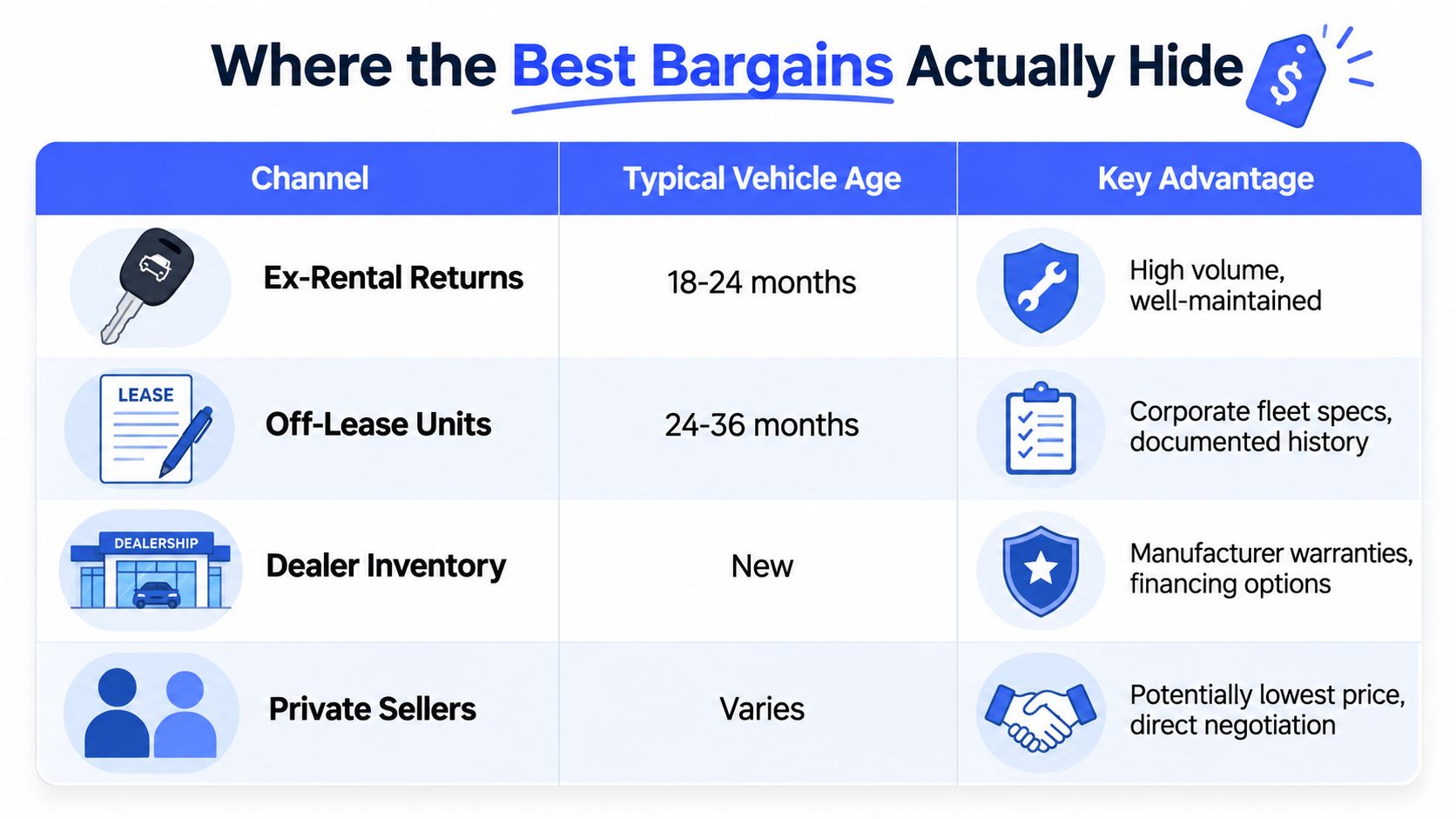
The cheapest cargo van often isn’t the one sitting under a large dealer sticker. Fleet buyers find better value by searching inventory with known use histories, documented service, and configurations that already match commercial work.
Ex-rental returns can offer high-volume inventory and consistent maintenance records. Off-lease units may have corporate fleet specifications and documented servicing. Dealer or bank auctions can surface off-program inventory, but first-time buyers shouldn’t bid without an independent inspection process. End-of-model-year clearance can also help when a manufacturer is replacing a platform, especially if the outgoing configuration already meets the route requirements.
Inspect the parts delivery work abuses
A mobile inspector should examine the roof rails, cargo floor, door tracks, hinges, suspension, tires, underbody, transmission behavior, and signs of repeated overloading. Delivery vans also need electronic checks for warning lights, charging systems, backup cameras, sensors, and telematics equipment.
Request the title, service history, recall status, auction condition report, inspection report, and any documentation showing commercial use. Verify the VIN across every document. Private sellers may offer direct negotiation, but the lower price doesn’t compensate for missing records or pressure to wire funds quickly.
A clean-looking cargo floor doesn’t prove a clean drivetrain. Test the transmission, inspect the underside, and verify the service history before treating the price as a bargain.
This video can help buyers recognize common used-van inspection issues, but it shouldn’t replace a professional mechanical review.
For a more disciplined way to evaluate vehicle history and buy smarter with provenance, compare the seller’s claims with title records, inspection findings, and maintenance documentation. The first-time fleet buyer should bring an experienced technician to auctions and private-sale inspections. That fee is small compared with buying a van that cannot support the route.
Negotiation and Financing Moves That Lower the Total Bill
Begin with the out-the-door price, not the monthly payment. Ask each seller for a written breakdown that separates the vehicle, financing, warranties, taxes, registration, documentation fees, and required upfits.
Get three competing fleet quotes before negotiating. Pull available dealer incentives, manufacturer fleet programs, and conquest offers in that order. An incentive may reduce the bill through equipment or financing rather than a visible vehicle discount, so read the eligibility and branding restrictions.
Keep every lever separate
- Vehicle price: Negotiate the van without allowing the seller to hide margin inside a monthly payment.
- Financing: Compare total interest and required cash, not just the advertised rate. Check whether the offer requires a down payment or restricts mileage.
- Trade value: Obtain an independent trade estimate so the dealer can’t make the new van look cheaper by overvaluing the old one.
- Protection products: Reject duplicate warranties and add-ons unless the coverage, exclusions, and price justify them.
- Service terms: Negotiate parts, maintenance, tire pricing, and repair-order response alongside the vehicle. A discount disappears when the van sits unavailable.
Leasing can preserve cash for a growing fleet, but calculate the purchase option, excess-mileage charges, damage standards, and contract length. The payment only makes sense if it matches the van’s expected service life and route mileage.
Cutting Per-Delivery Costs Through Smarter Operations
A van’s true cost is its operating expense divided by completed deliveries. That makes utilization more powerful than a small purchase-price win. A well-sized van running full routes can beat a cheaper van that carries empty space, drives extra miles, and spends more time in service.
Start with route sequencing. Reduce dead miles, unnecessary backtracking, difficult turns, and out-of-order driving. Test proposed routes against delivery windows and known traffic conditions, then compare planned performance with actual miles and completed stops. Route planning software can help convert a stop list into driver-ready routes, while vehicle assignment keeps route capacity visible.
Consolidate without overloading
Group deliveries by geographic zone, time window, service level, and physical characteristics. A shelving system can improve access and usable organization, but it adds weight, so measure the van’s payload after installation. Don’t confuse a full-looking van with a profitable van. A route that fills the floor but exceeds payload limits is a liability.
Driver behavior also affects the cost per stop. Train drivers to accelerate smoothly, brake early, check tire pressure, and avoid prolonged idling. Schedule preventive maintenance around the actual duty cycle, especially on routes with frequent curb approaches, backing, loading, and unloading.
Use one monthly tracker instead of relying on fleet averages:
| Metric | Current Month | Prior Month | Change |
|---|---|---|---|
| Delivery miles | Record actual | Record actual | Current minus prior |
| Completed stops | Record actual | Record actual | Current minus prior |
| Fuel used | Record actual | Record actual | Current minus prior |
| Idle time | Record actual | Record actual | Current minus prior |
| Labor hours | Record actual | Record actual | Current minus prior |
| Cost per delivery | Total route cost divided by stops | Prior calculation | Current minus prior |
For more actionable fleet management tips, focus on consistent records, preventive service, driver accountability, and vehicle availability. Recalculate cost per delivery every month and compare each route with its own prior performance.
A 30-day buying workflow
Days 1 to 5: Document daily miles, stop counts, cargo volume, heaviest load, curb frequency, weather exposure, and required upfits.
Days 6 to 10: Set maximum payload, cargo length, and clearance requirements. Shortlist new, used, and lease candidates without letting price override operational fit.
Days 11 to 15: Request three out-the-door quotes and fleet incentives. Build a total-cost model covering acquisition, fuel, insurance, maintenance, tires, downtime, and resale.
Days 16 to 20: Inspect used candidates mechanically and electronically. Verify title, service records, recalls, rust, accident repairs, mileage, and payload-label compliance.
Days 21 to 25: Negotiate equipment, financing, incentives, trade value, and service terms as separate items.
Days 26 to 28: Review mileage limits, warranty exclusions, financing precharges, damage rules, and cancellation terms.
By day 30: Select the vehicle with the lowest realistic cost per usable delivery capacity. Don’t rush a purchase if a short delay can reveal better records, fleet discounts, or a more suitable configuration.
Routelink helps delivery businesses import jobs, plan routes, assign vehicles, dispatch drivers through PIN-protected links, send customer updates, and collect proof of delivery. Visit Routelink to evaluate whether its route planning and delivery workflow can lower your cost per completed stop.