POD in Logistics: Types, Value, and Best Practices — Routelink
Learn what POD in logistics really means, the main proof of delivery types, why it protects cash flow, and how to run reliable POD workflows.
3 September 2026 · Routelink Team
POD in Logistics: Types, Value, and Best Practices
Learn what POD in logistics really means, the main proof of delivery types, why it protects cash flow, and how to run reliable POD workflows.
POD, or proof of delivery, is the record, including the recipient name, signature, timestamp, reference number, and condition notes, that confirms a shipment reached the right person and closes the delivery transaction. A complete POD protects the sender during disputes and gives the receiver a clear record of what was accepted.
A customer says the order never arrived. The driver remembers the address, the tracking page says “delivered,” and the invoice is already waiting in accounts receivable. The only document that can settle the argument quickly is a delivery record tied to that shipment and that recipient.
That’s why POD in logistics is more than a signature collected at a doorstep. It’s the final operational handoff between delivery, billing, customer service, and liability. When the record is complete, your team can answer questions with evidence instead of phone calls and assumptions. When it’s missing, a completed route can still leave an unpaid invoice behind.
Table of Contents
- What Is POD in Logistics
- The Main Types of POD Explained
- Why POD Matters for Your Business
- How a POD Workflow Works End to End
- Legal and Record-Keeping Requirements for POD
- Industry-Specific POD Considerations
- Choosing a POD Solution and Making It Work
What Is POD in Logistics
A pallet arrives at a customer’s warehouse, but two cartons are damaged. The driver remembers the handover, while the tracking system only shows “delivered.” The invoice is now disputed. A complete proof of delivery (POD) connects the shipment, recipient, time, location, and exceptions, giving operations and accounts receivable evidence to resolve the issue.
Proof of delivery is the final record confirming that a shipment was received by the correct recipient. It records acceptance and links the handover to a specific order. That record can support the carrier’s position in contractual or legal disputes, as explained in this guide to proof of delivery and its role in logistics.
A POD functions as a two-way receipt. The sender gains evidence that the goods reached the intended party. The receiver gains a record of what arrived, when it arrived, and whether damage or shortages were reported.
What a complete POD contains
A usable POD brings several details into one record:
- Recipient identity: The recipient’s name and signature identify who accepted the shipment.
- Delivery timing: The date and time establish when the handover occurred.
- Location: The delivery address and GPS data help confirm where acceptance took place.
- Shipment reference: A tracking or reference number connects the proof to the correct order.
- Shipment details: Product information shows what the receiver accepted.
- Condition evidence: Notes and photographs record visible damage, shortages, or other exceptions.
Each field answers a different operational question. A timestamp can support service-level checks. A reference number links the POD to an ERP or warehouse record. Condition notes and photos give customer service evidence for a damage claim instead of relying on memory. Teams reviewing how to improve delivery note workflows should also separate the delivery note from the POD, because the documents often support different parts of the handover.
POD versus delivery notes and tracking
A delivery note normally travels with the goods and describes the shipment’s contents. It helps the receiver check the order, but it may not identify the person who accepted it or record the handover location.
A tracking status such as “out for delivery” or “delivered” is a system update. It reports what the carrier system recorded, but may lack a signature, condition evidence, photo, or recipient identity.
POD closes the evidence gap between route completion and payment. A status can mark a delivery complete. A strong POD can help release an invoice, address a dispute, and show when liability moved at handover. On subcontractor routes, missing-proof rates can therefore affect cash collection as well as delivery control. Accurate records also prepare operations for machine-readable proof requirements emerging with EU e-transport rules by 2027.
The Main Types of POD Explained
Different deliveries need different evidence. A warehouse receiver may sign a paper form, while a residential driver may need a photo and location record. The right question isn’t “Which POD type is best?” It’s “Which combination proves acceptance, identity, location, timing, and condition for this delivery?”
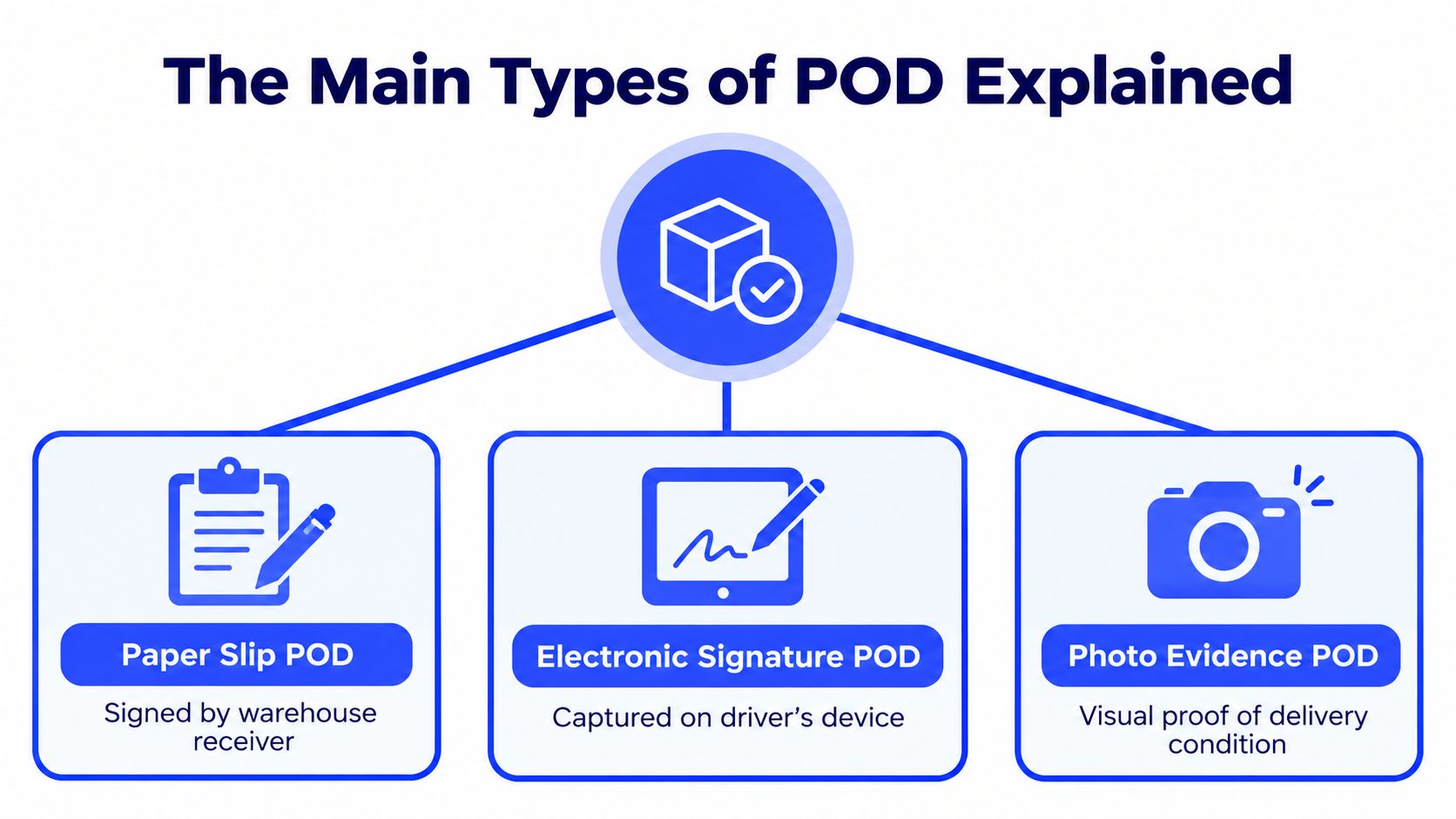
Paper slip POD
A paper slip works well when a warehouse receiver signs at a loading bay. It creates a physical record that can show the recipient, shipment details, date, time, and exceptions written at handover.
Its weakness is the back office. Someone must scan, file, name, and retrieve the document. A signature can also prove acceptance without proving the shipment was undamaged, unless the receiver writes clear condition notes.
Electronic signature POD
An electronic signature captured on a driver’s device gives the operation a digital record at the point of delivery. It can attach the signature to the order immediately and make retrieval easier for billing or customer service.
A signature still has limits. It may prove that someone accepted the goods, but it doesn’t automatically establish the condition of every item or prove that the signer had authority to accept them. Pair it with recipient details, timestamp, location, and exception notes.
Photo evidence POD
A photograph is valuable for unattended deliveries, parcels left at a designated location, or goods placed at a building entrance. It can show the delivery context and visible condition.
A photo usually proves location or placement better than identity. It doesn’t necessarily show who received the goods, so it works best alongside a recipient record, GPS data, and a clear delivery reference.
Barcode and pickup PODs
A barcode scan confirms that the driver handled the intended parcel, pallet, or container. It reduces the risk of documenting the wrong shipment, but the scan doesn’t by itself prove final acceptance or condition.
A pickup POD proves collection rather than delivery. It can show that a carrier took possession from a sender, which is important when responsibility changes at collection. It shouldn’t be confused with the later record confirming delivery to the consignee.
| POD Type | What It Proves | Best Use Case | Main Weakness |
|---|---|---|---|
| Paper slip | Signed physical acceptance | Warehouse and depot handovers | Manual filing and retrieval |
| Electronic signature | Digital recipient acceptance | Driver-led business deliveries | Doesn’t prove condition alone |
| Photo evidence | Delivery setting or visible condition | Unattended or residential drops | Doesn’t prove recipient identity |
| Barcode scan | Correct item handling | Parcels, pallets, and containers | Doesn’t prove acceptance alone |
| Pickup POD | Collection by the carrier | First-mile handover | Isn’t final delivery confirmation |
Practical rule: Use more than one evidence type when the delivery carries meaningful dispute risk. A signature plus photo, tied to the correct reference number, is stronger than either item alone.
Why POD Matters for Your Business
POD is the last domino in the order-to-cash chain. The order is created, the goods are dispatched, the driver completes the stop, and the invoice waits for evidence that the customer received what was promised. If that final record is incomplete, invoicing and collections can stall even when the physical delivery went smoothly.
That creates a working-capital problem, not just an administrative one. POD gaps can increase days sales outstanding, and even a small missing-proof rate can affect cash flow. Subcontractor-heavy routes may experience higher rates of missing proof, creating a recurring cash-flow drag for the carrier or delivery business.
How missing proof delays money
DSO is the time your business waits to collect money after making a sale. A useful analogy is a locked cash drawer. The delivery may be complete, but the invoice team can’t safely open the drawer until the evidence is attached.
Missing proof can lead to:
- Invoice holds: Accounts receivable waits for the signed or digital record.
- Customer disputes: The buyer questions whether delivery occurred or whether the shipment was complete.
- Manual chasing: Staff contact drivers, depots, and subcontractors for documents.
- Slower reconciliation: Teams struggle to match proof to orders, invoices, and route records.
The effect is easy to miss because each individual gap looks small. Across repeated subcontractor routes, however, those gaps can become a regular delay between delivery and payment.
POD also protects the service relationship
A good record settles more than billing questions. Condition notes and photos can show whether damage was visible at handover, whether packaging had already failed, or whether the receiver accepted the goods with an exception.
Customers also get faster answers. Sending a dated proof record is more useful than asking a driver to remember what happened during a busy route. The same record gives managers a way to review driver and subcontractor performance without treating every complaint as a matter of opinion.
Weak POD turns a completed delivery into an open question. Strong POD turns it into a closed transaction.
How a POD Workflow Works End to End
A reliable POD workflow starts before the vehicle leaves the depot. The delivery job needs a unique reference number, the correct recipient and address, the products being transported, and any evidence requirements attached to the stop.
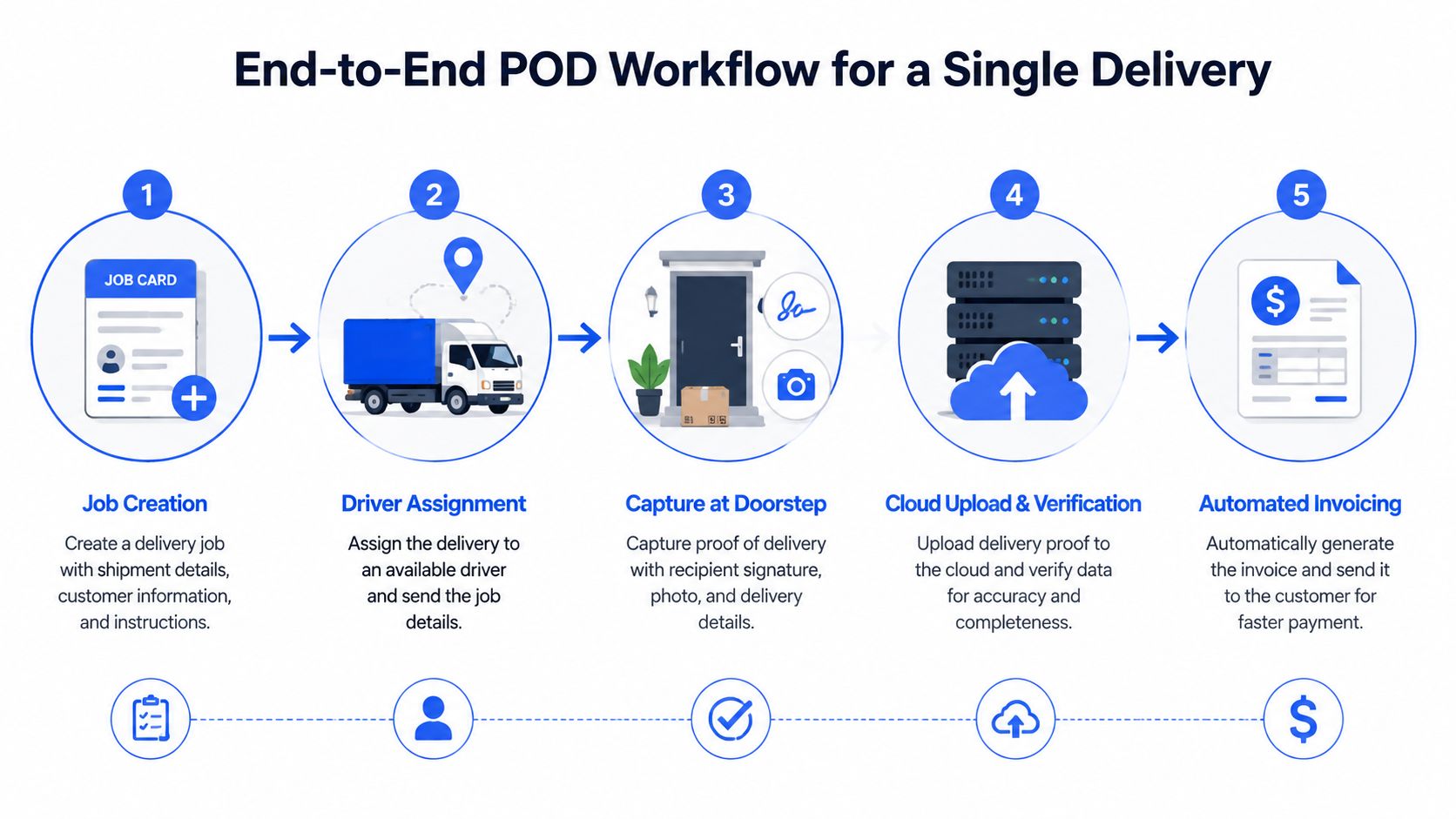
Follow one delivery from dispatch to archive
First, create and link the job. The order or shipment enters the delivery system with its tracking reference. That identifier should remain attached to every later record, including the driver assignment, customer notification, proof file, and invoice.
Next, assign the driver. The driver receives the stop details and knows what evidence to collect. If a subcontractor is involved, the process should be simple enough that the driver can complete it without learning a complicated application during a busy shift.
At the doorstep, the driver captures the evidence required for that shipment. That may include a sign-on-glass signature, recipient name, photo, barcode scan, condition note, timestamp, and location. The driver should record exceptions immediately, while the goods and delivery setting are still visible.
The system then uploads and verifies the record. A good workflow attaches the proof automatically to the matching order instead of leaving a photograph in a phone gallery or a signature in an email inbox. Teams can use BoloSign delivery confirmation templates as a reference when standardizing confirmation documents and signature workflows.
Design out the common failure points
A driver may forget the photo, capture a signature without a timestamp, or save a paper form that never reaches billing. The process should respond with required fields, prompts, reference matching, and immediate upload rather than relying on memory.
When a dispute arrives later, the dispatcher searches by order or shipment reference and retrieves the complete record. For a practical walkthrough of the capture stage, see capturing proof of delivery in a delivery workflow.
The important operational lesson is simple: POD quality is decided during capture. Back-office staff can organize a record, but they can’t recreate a missing photograph, an unrecorded condition exception, or an unclear recipient after the vehicle has left.
Legal and Record-Keeping Requirements for POD
POD can mark the handover point where custody and liability move from the carrier to the consignee. A signature alone does not settle every legal question. It creates a shared record of who accepted the shipment, where acceptance occurred, and what condition the goods appeared to be in at handover. That record can become the evidence used to resolve an invoice dispute or challenge a damage claim.
Government and regulated freight workflows often require more than a name and signature. The record may include the receiving organization and address, contract or order numbers, delivery date, origin and destination, shipped weight, and number of pieces. Together, these identifiers form an auditable chain when a shipment passes through several hands, as described in this government explanation of proof of delivery requirements.
A practical retention checklist
A logistics manager should confirm that the business can:
- Keep the complete record: Store recipient details, shipment reference, timing, location, signature, and condition evidence together.
- Protect the original evidence: Preserve photos and electronic records in a system that limits casual alteration and records changes.
- Find records quickly: Search by order, customer, route, driver, or shipment reference.
- Control access: Give billing, customer service, operations, and compliance teams the access they need while preserving an audit trail.
Retention periods depend on contracts, jurisdiction, freight category, and customer requirements. Treat published guidance as a planning reference, then confirm the exact rule that applies to each operation. A clear receipt for delivery process also helps teams standardize which document is issued, where it is stored, and how billing staff retrieve it. If records sit in separate inboxes or phone galleries, retrieval takes longer and invoice approval can stall, increasing DSO.
Why machine-readable proof matters
Digital transport documentation is moving toward stronger interoperability. In 2026, FedEx announced enhanced GPS proof-of-delivery data to address missing-location gaps in webhook payloads (FedEx webhook announcement on enhanced GPS POD data). EU transport rules are expected to require mandatory acceptance of electronic transport documents by 9 July 2027, with 2026 described as an adoption turning point.
The operational direction is clear. A scanned signature that a person can open remains useful, but connected systems also need structured fields they can validate, search, share, and attach to billing or compliance records. That machine-readable layer makes exceptions easier to find and helps managers measure missing-proof rates on subcontractor routes before they become payment disputes.
Industry-Specific POD Considerations
One POD template can’t serve every delivery. The standard identity, timing, location, reference, product, signature, and condition fields form the base, but each industry adds evidence around its main risk.
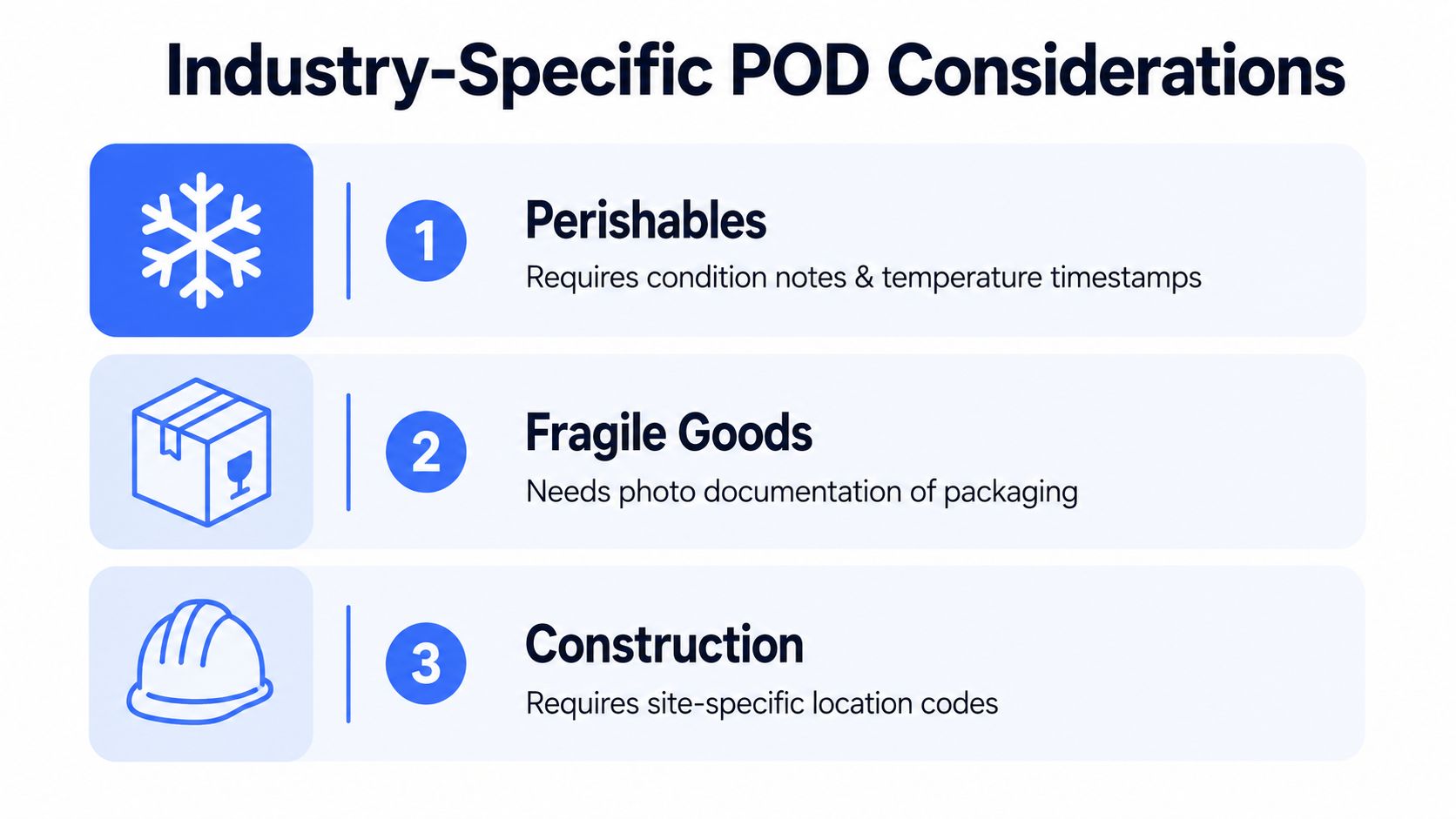
Perishables
A receiver may report spoiled produce or damaged chilled goods after the driver has left. The useful evidence is captured at the door, while the shipment is visible and the handover is fresh.
Add detailed condition notes and relevant temperature timestamps to the normal POD. The timestamp helps establish when the goods arrived, while the condition record shows whether the receiver accepted them with an exception.
Heavy and fragile goods
A pallet of building materials creates a different risk from a small parcel. The receiving party may accept the goods, but later dispute where they were placed, whether packaging was intact, or whether damage occurred during unloading.
Use a signature plus photographs of packaging, placement, and visible exceptions. For fragile goods, photograph the package before and after handover when the process allows it. A signature says “accepted,” but images and notes provide context for the condition claim.
Scheduled and construction deliveries
A scheduled delivery depends on more than completion. The operation may need to show that the driver reached the correct site, at the agreed time, and followed site-specific instructions.
Capture precise timestamps, location data, site or entrance identifiers, and any receiver notes. Construction deliveries may also need a location code, placement instruction, or named site contact.
Rule of thumb: Add evidence wherever the customer could later disagree about condition, timing, placement, or the exact point of handover.
Choosing a POD Solution and Making It Work
Choose a POD system by starting with operational outcomes, not feature lists. You need to know whether drivers capture usable evidence, whether billing receives it quickly, and whether your team can find it when a customer raises a question.
Measure POD health first
Define the measures before changing the workflow:
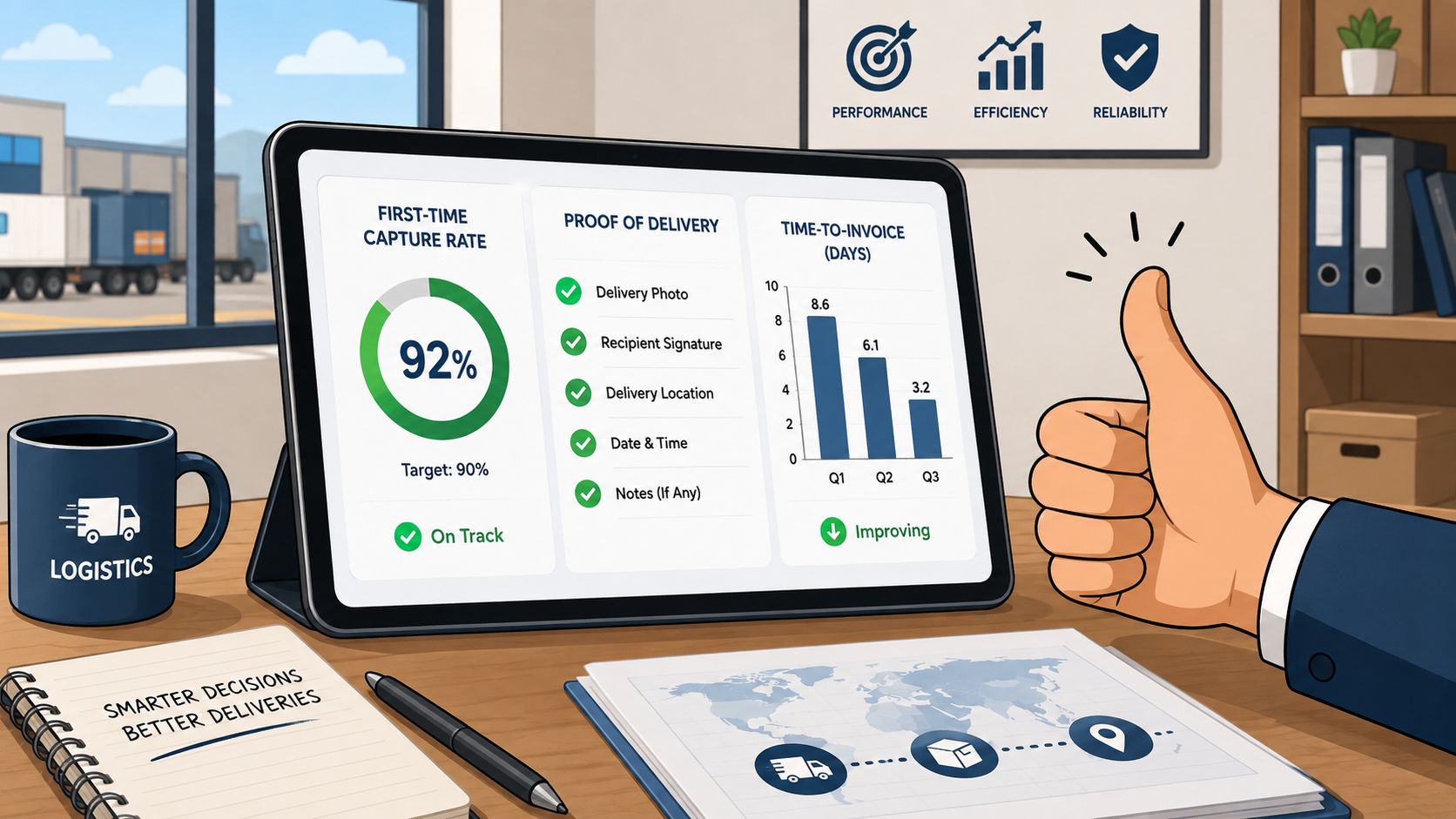
- First-time capture rate: The share of deliveries that receive complete proof without back-office chasing.
- Missing-proof rate: The share of completed deliveries that lack the required evidence.
- Time to invoice: The time between delivery completion and invoice readiness.
- Dispute resolution time: The time needed to find evidence and close a delivery or damage question.
- On-time performance: The proportion of deliveries completed within the promised service window.
These measures reveal different failures. A high first-time capture rate with slow invoicing may indicate a disconnected billing process. A poor missing-proof rate on subcontractor routes may point to onboarding, access, or compliance problems rather than driver effort alone.
Screen the technology against real routes
Look for no-app driver access when subcontractors or temporary drivers matter. A PIN-protected link can reduce onboarding friction, while automatic timestamps and GPS records reduce manual entry.
The capture screen should support the evidence your operation needs:
- Sign-on-glass signatures for recipient acceptance.
- Photo capture for placement, packaging, and condition.
- Reference matching so proof attaches to the correct order.
- Customer notifications that include delivery confirmation.
- System integration with the order, route, warehouse, or finance workflow.
The market reflects the broader shift toward these workflows. One estimate valued the global proof of delivery software market at $2.1 billion in 2025 and projected it to reach $5.4 billion by 2034, with a compound annual growth rate of 11.8% (proof of delivery software market estimate). The figures are projections, but they show that digital POD is now a substantial logistics technology category.
Fix the workflow, not just the missing field
If drivers skip photos, make the photo mandatory for the relevant stop type and explain what a useful image must show. If subcontractors submit proof late, give them a simple access method and monitor missing-proof performance by route or partner. If systems don’t connect, use the shipment reference as the common key and automate attachment wherever possible.
Routelink combines route planning, driver dispatch, customer notifications, and POD capture in one workflow. Its delivery process supports PIN-protected driver links, sign-on-glass e-signatures, photo uploads, timestamps, and live customer updates. For a broader view of selection criteria, review this guide to proof of delivery software.
Finish with a small set of operating rules: require the right evidence at capture, attach it to the correct order, alert the customer promptly, review missing-proof exceptions daily, and connect POD completion to invoice readiness. That turns delivery confirmation from a filing task into a dependable control over service quality and cash collection.
Routelink brings route planning, driver dispatch, customer notifications, and proof of delivery into one workflow, with PIN-protected driver links, electronic signatures, and photo capture. Visit Routelink to see how you can make delivery evidence easier to collect, retrieve, and use for faster invoice processing.